
A Pilgrimage on the Rock: Visiting Madonna della Corona
Madonna della Corona has been a place of devotion for centuries, its origins tracing back to at least the 11th century, when hermits are believed to have lived in caves carved into the sheer rock face of Monte Baldo. According to tradition, a statue of the Virgin Mary was miraculously brought to the site in the 16th century, solidifying its importance as a pilgrimage destination. Over time, the precarious hermitage evolved into a sanctuary, with wooden walkways eventually replaced by stone paths and staircases to make access safer for pilgrims. In 1625, Madonna della Corona was formally recognized as a sanctuary, and through ongoing restorations and expansions, it has remained a powerful symbol of faith, perseverance, and human ingenuity—quite literally built into the mountain itself.
April of this last year I was fortunate enough to travel to Northern Italy. As a traveler heading into unfamiliar places, I spent many evenings researching things to do, and that is when I first came across Madonna della Corona. From the very first photographs—this church seemingly suspended from the face of a mountain—I was both intrigued and a little obsessed. It felt impossibly remote, carved into stone rather than built upon it, and I knew I had to try to get there.
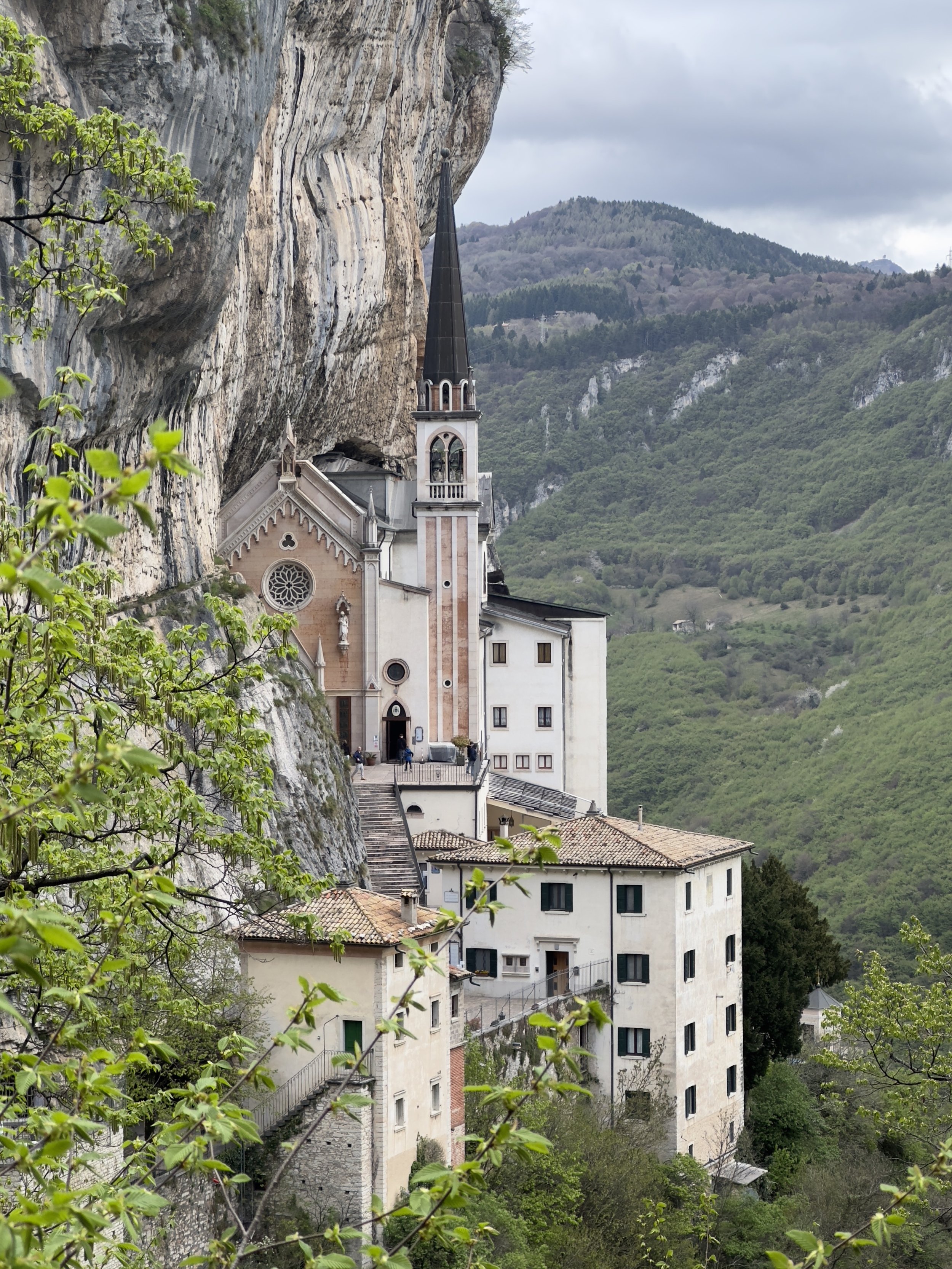
Madonna Della Corona
Getting There and Back: Transportation to Madonna della Corona
Reaching Madonna della Corona requires some planning, especially if you are traveling without a car. While the sanctuary feels wonderfully isolated, transportation options become limited once you leave the main routes of Veronaand Lake Garda and head into the mountains.
From Verona, travelers can take a train to Domegliara–Sant’Ambrogio or Peri, then connect by local bus or taxi toward Spiazzi, the small mountain village that serves as the primary trailhead. From Lake Garda, buses and taxis usually pass through Caprino Veronese before continuing uphill to Spiazzi. These connections work, but schedules are infrequent and highly seasonal.
During the summer months (generally June through September), public transportation becomes more accessible. ATV bus line 476 operates seasonally between Lake Garda towns—such as Garda, Bardolino, and Cisano—and Spiazzi. From there, a local shuttle (ATV line 499) runs between Spiazzi and the sanctuary. This shuttle typically operates from spring through autumn, with buses about every 30 minutes on weekdays and more frequently on weekends and holidays.
Taxis are another option from Verona, Lake Garda, or Spiazzi, though availability can be unpredictable. I attempted to use my Uber app while in Spiazzi, assuming it would be a simple solution. Although the app showed cars nearby, none accepted the ride. After nearly an hour and a half, I gave up entirely—ride-share services simply aren’t reliable in this rural mountain area.
Fortunately, the taxi driver who dropped me off had warned me that transportation out of Spiazzi could be difficult. Before leaving, he gave me his direct phone number, just in case. Since I was staying between Verona and Lake Garda, I called him when I was ready to leave. He returned to pick me up, turning what could have been a stressful situation into a smooth and reassuring end to the day.
Morning in Spiazzi – A Quiet Beginning
It was an early Wednesday morning, and the forecast called for overcast skies with a chance of light rain. Unfortunately, due to my schedule, this was the only day I could attempt the visit. I grabbed a taxi from the bed and breakfast where I was staying and was dropped off at the start of the trail.
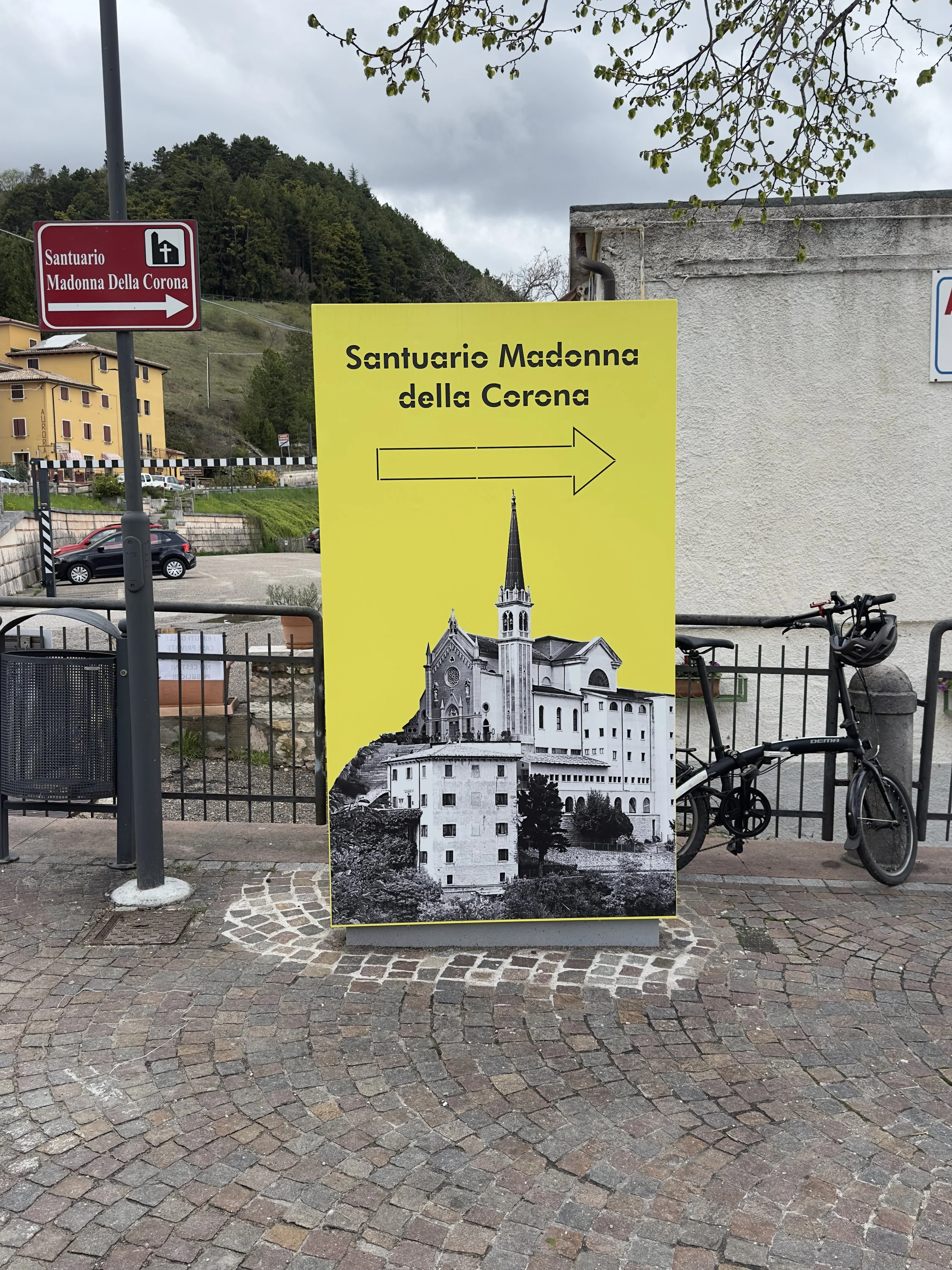
Entrance to the walking trail to Madonna Della Corona. It is next to a parking lot with about 50-60 total parking spaces and near the shuttle area.
The town of Spiazzi felt completely asleep when I arrived around 9 a.m. Shops were closed, streets were empty, and the stillness only deepened the sense that I was stepping into something timeless.
The Trail: Steps, Silence, and the Stations of the Cross
From Spiazzi, the trail to the sanctuary is relatively short—about 1.5 to 2 kilometers—but steep, descending along hundreds of stone steps and shaded switchbacks carved into the mountainside.
Along the way are the Stations of the Cross—life-sized sculptural mock-ups depicting the stages of Christ’s Crucifixion. These figures are deeply expressive, placed deliberately along the path so that reflection becomes unavoidable. Walking past them, step by step, turned the descent into something more than a hike; it became a quiet pilgrimage.
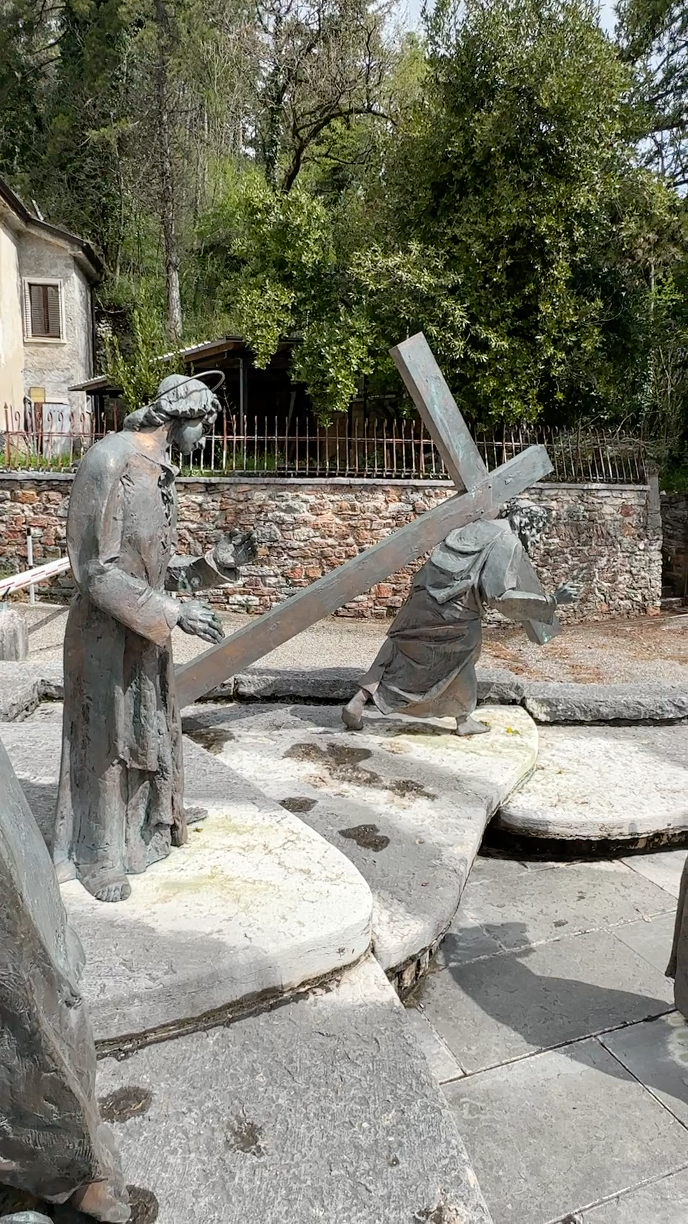
As you walk the trail, the different staged of the crucifixion of Christ is played out in full sized bronzed figures
There are two trails at the start. Without knowing why, I chose the one that veered to the right. I’m so glad I did.
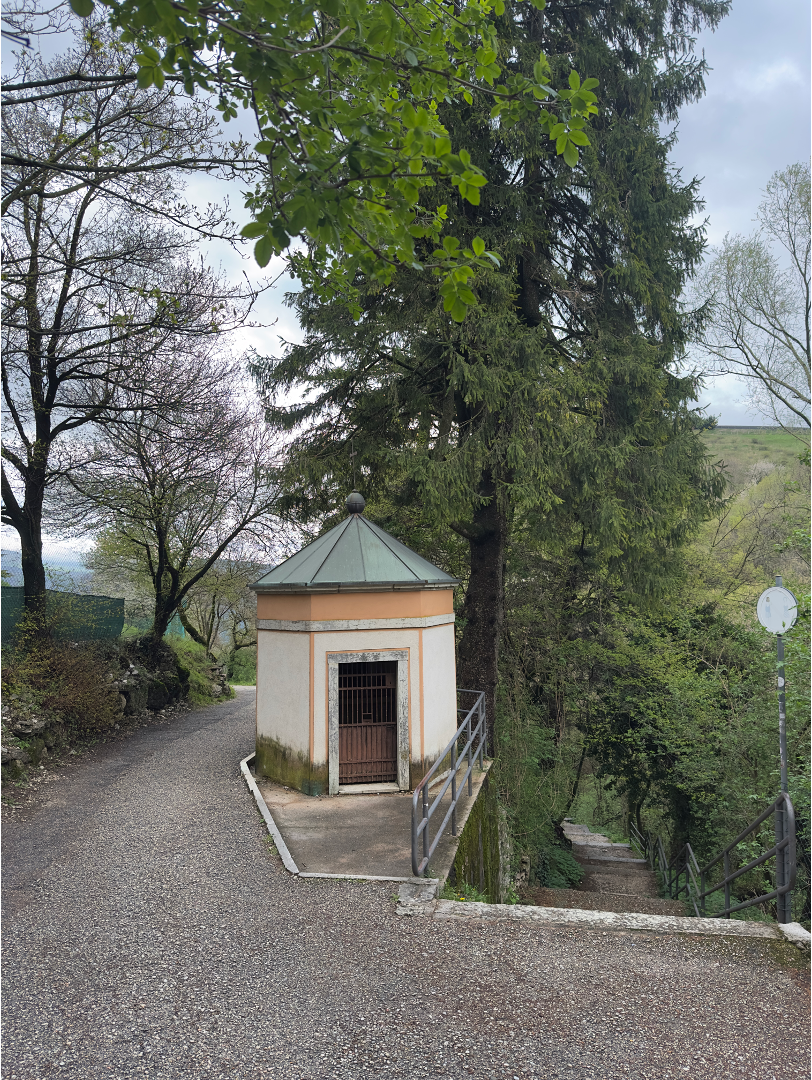
Just a bit into the trail, you will be faced with a decision, take the easy path to the left, or take the path less traveled to the right.
The Panoramic View: A Moment of Grace
Partway down, I encountered a sign offering a choice: a shorter route directly to the church, or the “Panoramic Terrace” trail. I took the panoramic route without hesitation.
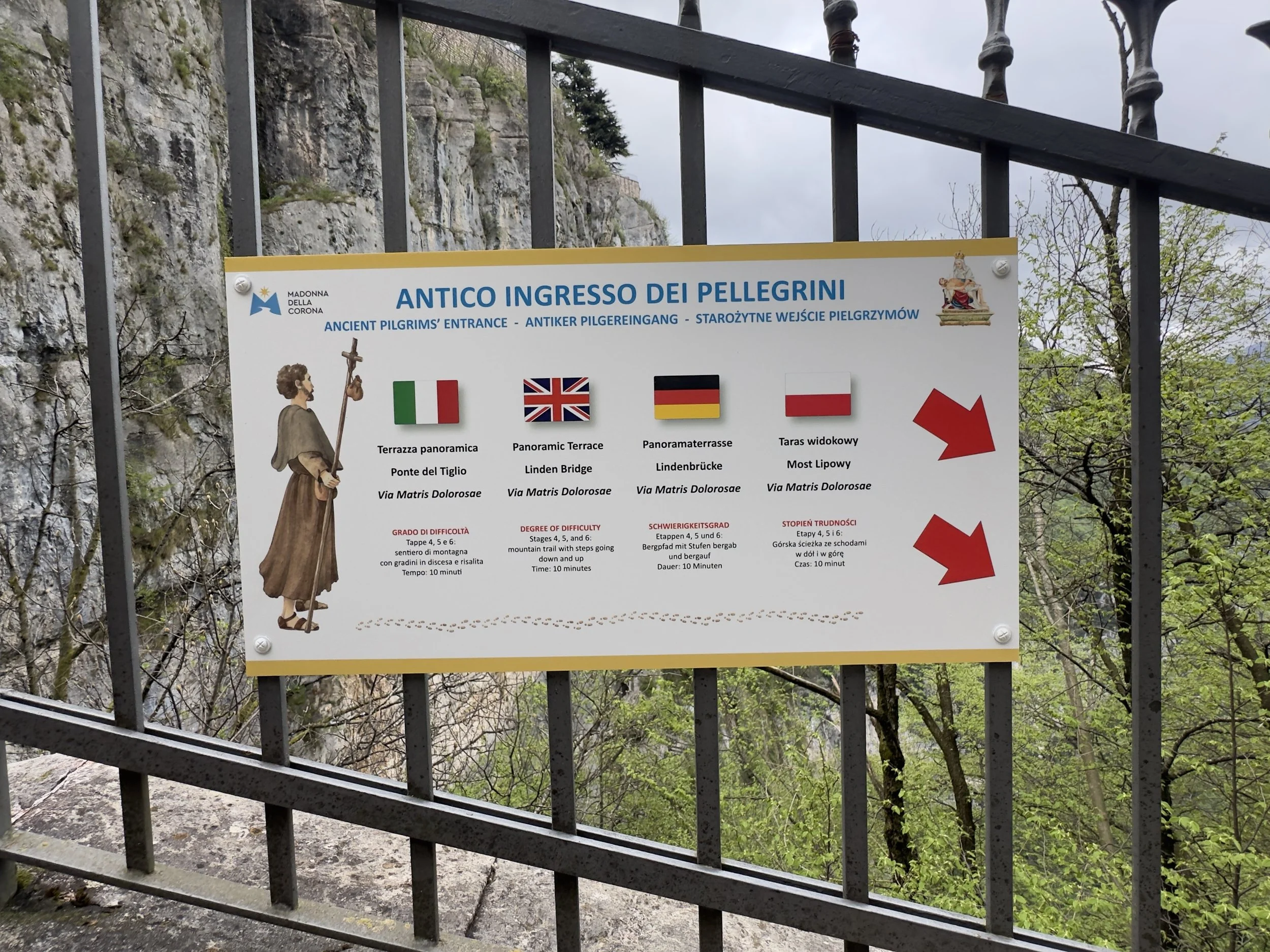
About ten minutes later, I reached a clearing with a breathtaking, unobstructed view of Madonna della Corona—framed by trees, set slightly above me, and seemingly emerging from the rock itself. The weather had held: overcast skies, cool air, no rain. I was completely alone.
Then I heard it—the faint sound of morning prayers broadcast from the sanctuary, echoing softly through the valley. I closed my eyes and stood still, listening. Something in that moment felt overwhelming, and I quickly set up my camera to record a time-lapse.
As the prayers continued, the clouds began to break apart. Sunlight spilled over the ridge and illuminated the church as if a spotlight had been turned on from above. For the next two hours, I simply stayed there, watching, listening, and absorbing everything around me.
Descending into the Sanctuary Courtyard
From the panoramic viewpoint, the path transitions into a long staircase leading directly into the lower courtyard of Madonna della Corona. Walking down those steps felt ceremonial. With each step, the sanctuary grew larger and more intimate.
When I finally stepped into the courtyard and looked up—stone walls pressed into the mountain, sky opening above—it was impossible not to feel the weight of history, faith, and devotion that built this place.
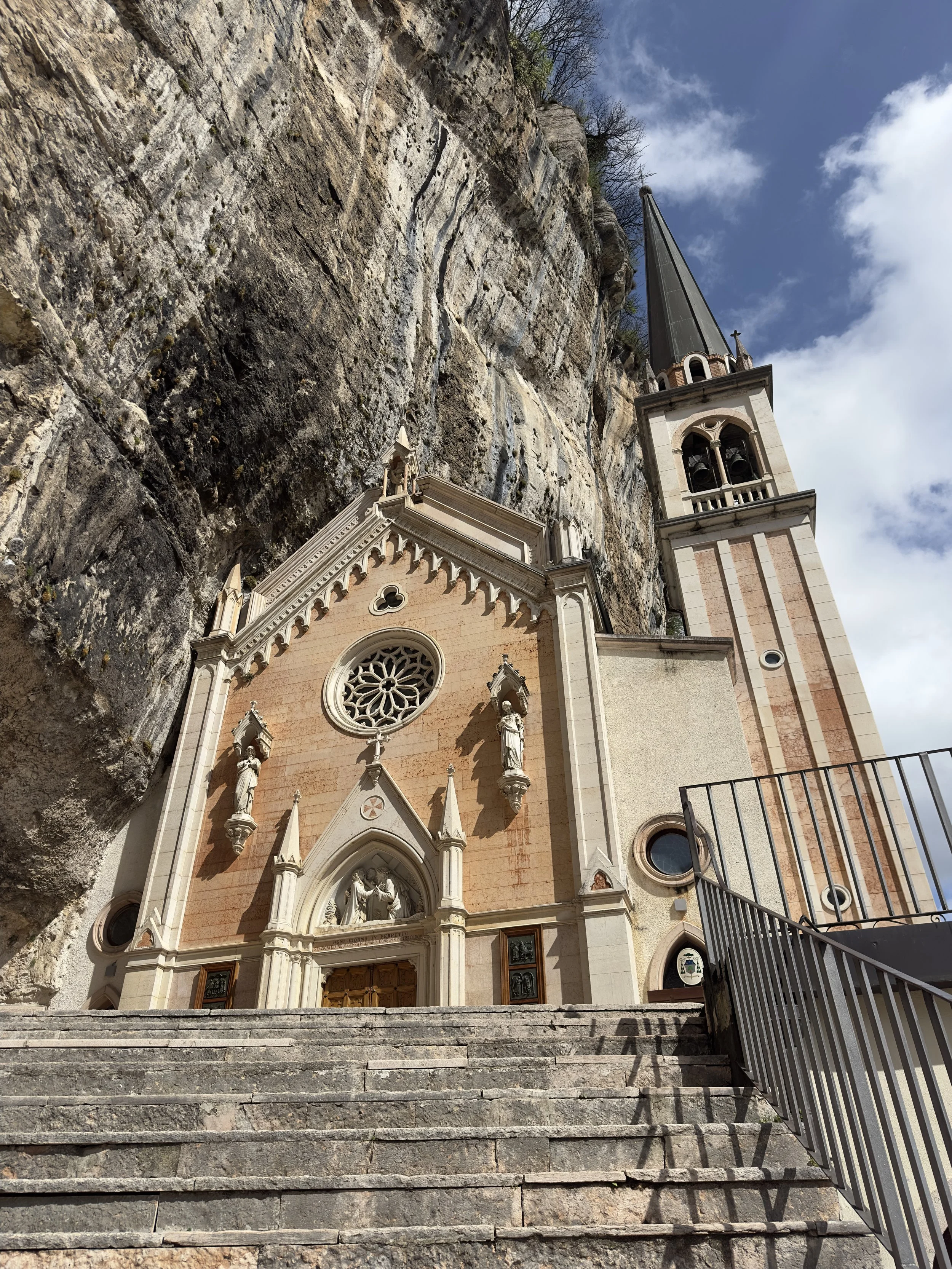
Final Steps to the Sanctuary of Madonna Della Corona
Guided Tour Options Worth Considering
Why This Place Stayed With Me
Standing there, pressed against the mountain, I found myself asking why this place affected me so deeply. Perhaps my soul was hungry for a truly spiritual experience—one that demanded silence, effort, and presence. Perhaps the engineer in me was in awe of the sanctuary itself, a structure quite literally carved into the side of a mountain, defying gravity and time through human devotion and ingenuity. Or perhaps it was the feeling that the story of the Crucifixion of Christ—so vividly depicted along the trail—was unfolding in front of me, not as history, but as something living and immediate.
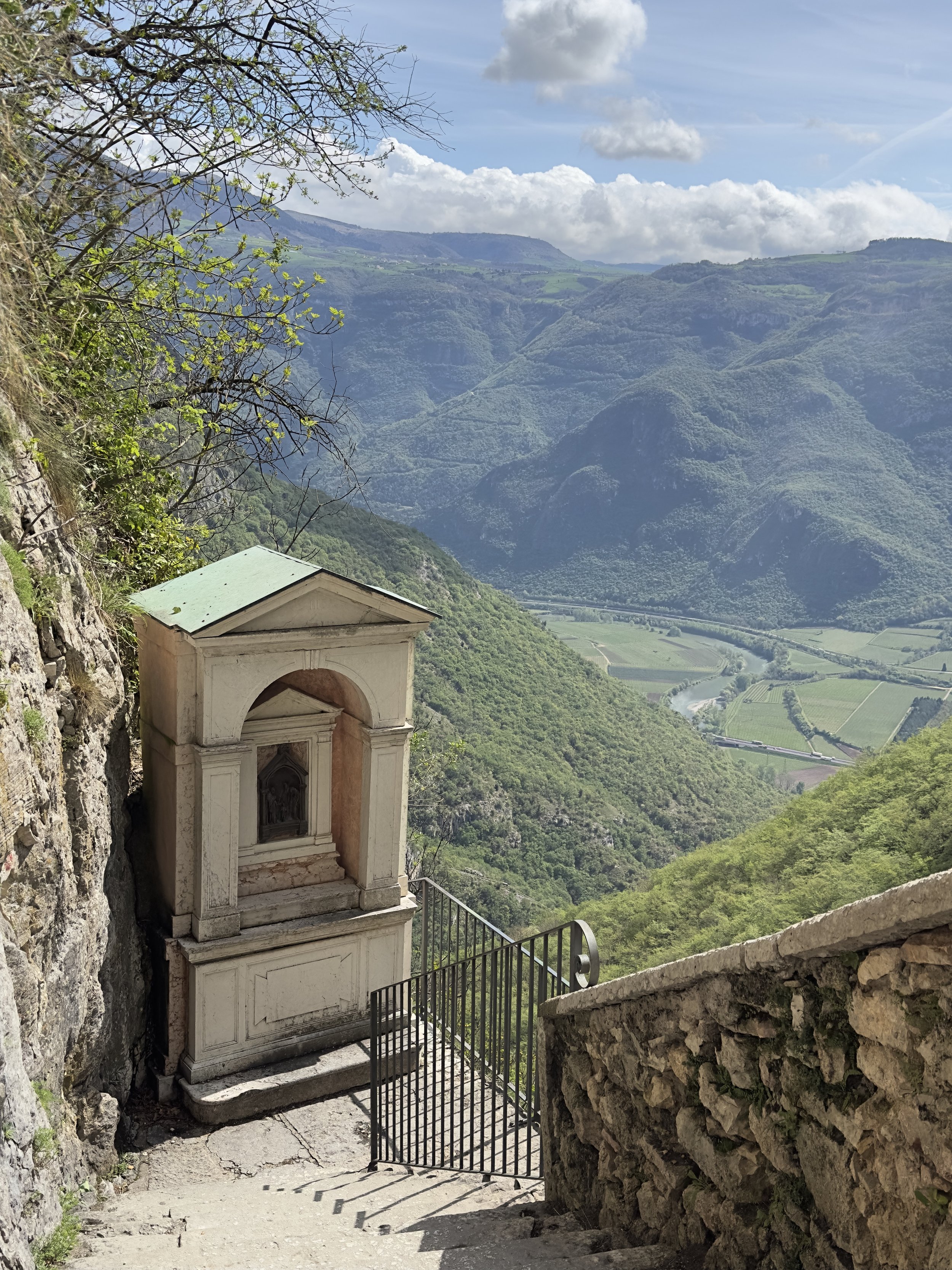
The view over the valley taking the steps from the Panoramic Terrace up to the Sanctuary Madonna Della Corona.
In that moment, surrounded by stone, sky, prayer, and light, everything slowed down. The physical journey, the Stations of the Cross, the quiet descent, and the breaking of sunlight converged into a truly spiritual experience.
Madonna della Corona is not just a destination. It is an experience that meets you exactly where you are—and stays with you long after you’ve left the mountain behind.
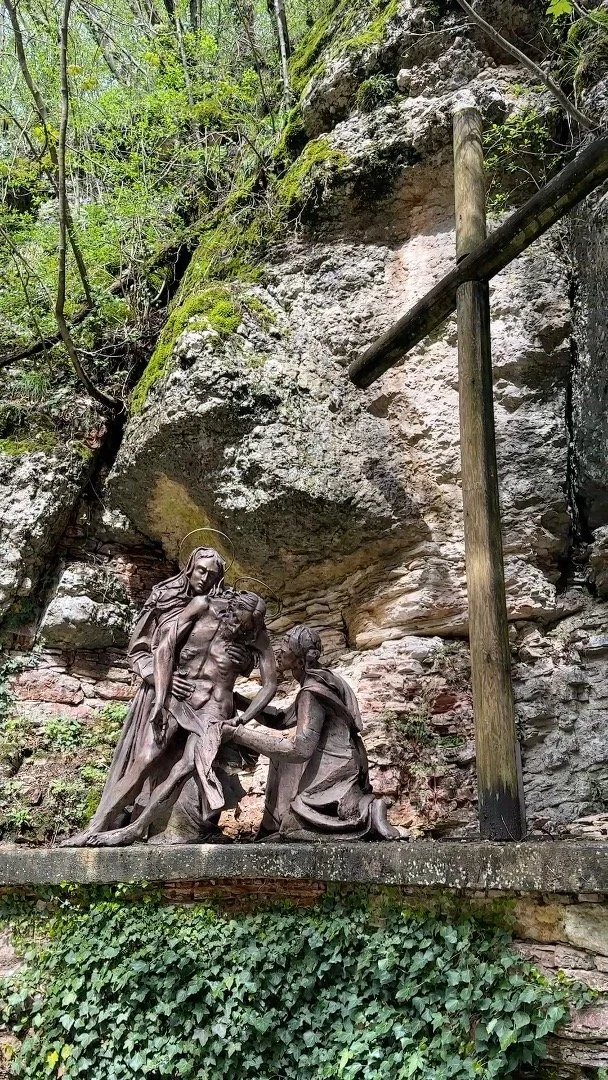
One of the many stages of the Crucifixion of Chris along the trail to the Sanctuary Madonna Della Corona.
