
The Kimberley
A plateau of 1.8-billion-year-old rock, cut by thousand-metre gorges and drowned by 12-metre tides. The Kimberley Coast stretches 2,500km of near-roadless wilderness — Aboriginal rock art galleries older than the Pyramids, saltwater crocodiles in every tidal creek, and humpback whales raising calves in warm sheltered bays. This is Australia at its most ancient and its most untouched.
Seasons & best months to visit
The Kimberley operates on a binary calendar that has no equivalent in any other expedition destination in this guide series. There is the Dry Season, when the coast is accessible, benign, and spectacular — and there is the Wet Season, when monsoon rains, cyclones, flash floods, and sea conditions make the entire coastline genuinely inaccessible to expedition vessels. There is no overlap and no compromise.
Early Dry Season
The Wet Season retreats and the Kimberley emerges transformed — waterfalls are still flowing from residual moisture, the vegetation is green and lush, and the humidity has not yet fully dropped. Temperatures remain warm (28–34°C). Excellent conditions for swimming in freshwater pools and photographing waterfalls at higher flow. Humpback whales begin arriving in the region from Antarctic feeding grounds. A rewarding start to the season with lower visitor numbers.
Peak Dry Season
The finest expedition window. Temperatures moderate to 26–32°C with low humidity. Skies are reliably clear; seas calm; the tides are at their most predictable. Humpback whale mothers and calves are present in greatest numbers — the shallow, warm waters of the Kimberley provide ideal calving habitat. Whale sharks aggregate in the Ningaloo–Kimberley corridor. Aboriginal rock art visits are most accessible with dry ground. Sunrise and sunset light on the red sandstone gorges is extraordinary.
Late Dry Season
Temperatures begin climbing toward 35–38°C in October. Waterfalls have reduced but the landscape retains the ochre-gold tones of late dry season. Humpback whales begin their southward migration — late September and October see the most whale activity along the outer coast as pods move toward Antarctica. Snubfin dolphin encounters peak in sheltered bays. The returning build-up of humidity announces the approaching Wet Season from late October.
Wet Season
The monsoon transforms the Kimberley utterly. Rainfall can exceed 1,000mm in a single storm event. Cyclones track along the coast; rivers flood to 10m above dry-season levels; roads wash out completely. Sea conditions are severe and unpredictable. The Kimberley becomes one of the most inhospitable coastlines in the Southern Hemisphere. No expedition cruising operates during this period. The crocodiles, however, are extraordinarily active — breeding season peaks during the Wet.
Horizontal Falls
The "eighth wonder of the world" according to Sir David Attenborough — two narrow gorges in the McLarty Range through which an entire tidal sea forces itself twice daily, creating a horizontal waterfall effect of extraordinary power. Water rushes through the outer gap at up to 8 knots; the inner gap at 4 knots. At peak tidal exchange, standing waves form in the channel. Experienced by tender or helicopter; the physics of this tidal anomaly — unique in the world — are genuinely astonishing.
Mitchell Falls
Punamii-unpuu in Wunambal Gaambera language — four-tiered sandstone falls of extraordinary beauty, fed year-round by springs in the Mitchell Plateau. The surrounding plateau hosts one of the Kimberley's most significant concentrations of Wandjina and Gwion Gwion (Bradshaw) rock art. Accessible by helicopter from expedition vessels. The plunge pools at the base of Mitchell Falls are freshwater — the only safe swimming on the Kimberley Coast, as crocodiles cannot ascend the falls.
Montgomery Reef
At low tide, Montgomery Reef rises 3m out of the sea as the tidal water drains off it in a series of waterfalls and cascades — an extraordinary spectacle where the reef itself appears to emerge from the ocean. Dugongs graze in the shallow water; green turtles rest on the exposed reef surface; sea eagles hunt exposed fish. The reef emergence can only be observed at precisely the right tidal moment — expedition timing is critical. One of the most unusual tidal phenomena accessible from a vessel anywhere in Australia.
King George River & Falls
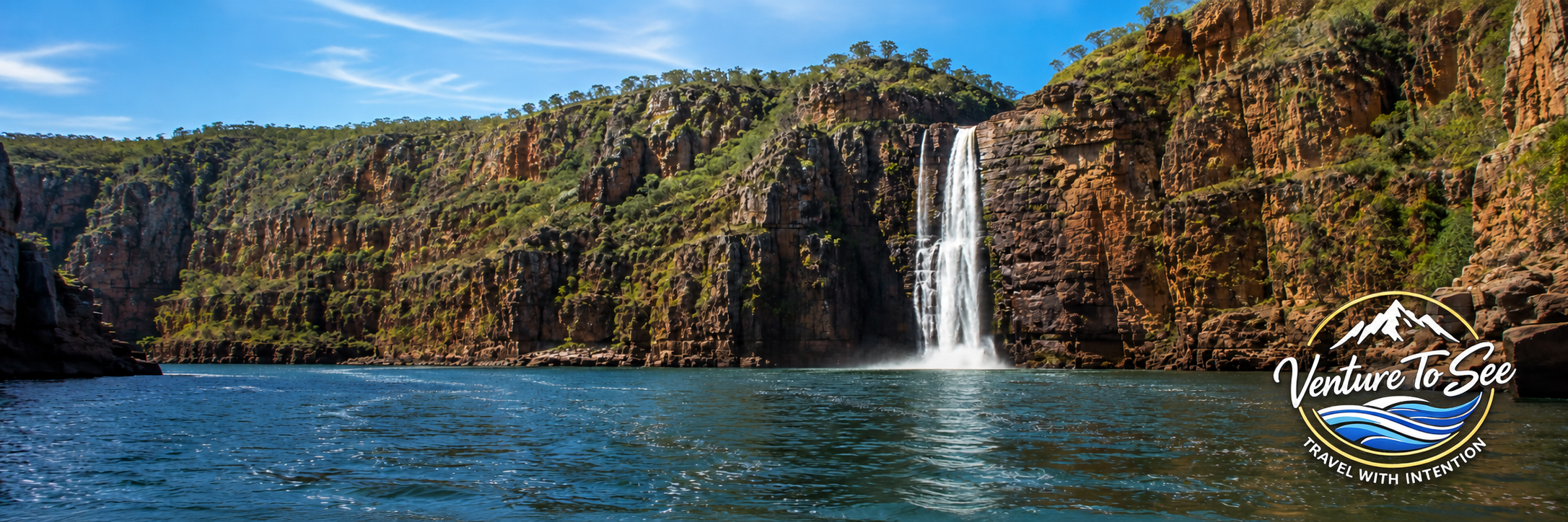
The King George River cuts through sandstone plateau to deliver twin waterfalls of 80m and 67m height into a gorge accessible only by tender. The walls of the gorge are vertical sandstone rising 90m — a scale that makes occupants of tenders feel genuinely insignificant. Freshwater crocodiles (Crocodylus johnstoni) rest on ledges above the waterline; white-quilled rock pigeons (Petrophassa albipennis) nest in cliff crevices. One of Australia's great hidden waterfall destinations — entirely inaccessible except by sea.
Gwion Gwion & Wandjina Rock Art
The Kimberley contains the world's oldest and most extensive gallery of rock art — two distinct traditions separated by tens of thousands of years. Gwion Gwion (Bradshaw) figures, painted in red ochre and dating to at least 17,000 years BP, depict elegant human figures in ceremonial dress. Wandjina spirit figures — large-eyed, halo-headed beings associated with rain and creation — were painted more recently and remain sacred to Ngarinyin, Wunambal, and Gaambera peoples. Many sites are accessible only by expedition vessel. Always visit with Aboriginal cultural custodians.
Buccaneer Archipelago
An extraordinary tidal archipelago of over 800 islands — drowned river valleys of ancient sandstone, exposed and submerged by the highest tides in the Indian Ocean. The labyrinth of channels, bays, and islands creates habitats for dugongs, dolphins, sea eagles, ospreys, and enormous schools of fish following the tidal movements. The Derby-based pearl farms here produce some of the world's finest South Sea pearls. A complex, three-dimensional navigational environment accessible only to experienced local-knowledge operators.
Monthly weather patterns
Data reflects the Broome and central Kimberley Coast region (17–18°S) — the primary expedition embarkation area and most representative climate data for the accessible coast. The far east Kimberley (Wyndham, Kununurra area) is hotter and receives less coastal cooling. Temperatures throughout the Kimberley are significantly moderated by the sea breeze afternoon cycle.
| Month | Air Temp (°C) | Sea Temp (°C) | Daylight | Precipitation | Sea Conditions | Season |
|---|---|---|---|---|---|---|
| January | 27 to 36°C | 28 to 31°C | 12–13 hrs | Monsoonal, 150mm+ | Rough / cyclone risk | Wet season |
| February | 27 to 36°C | 29 to 32°C | 12–13 hrs | Monsoonal, 180mm+ | Rough / cyclone risk | Wet season |
| March | 27 to 35°C | 29 to 31°C | 12 hrs | Monsoonal, 90mm | Rough — retreating | Late wet |
| April | 24 to 33°C | 27 to 29°C | 11–12 hrs | Showers, 20mm | Calm–Moderate | Early dry |
| May | 21 to 31°C | 25 to 27°C | 11 hrs | Dry, 10mm | Calm | Dry season |
| June | 18 to 29°C | 23 to 25°C | 10–11 hrs | Dry, 2mm | Calm | Peak |
| July | 17 to 29°C | 22 to 24°C | 10–11 hrs | Dry, 1mm | Calm | Peak |
| August | 18 to 31°C | 23 to 25°C | 11–12 hrs | Dry, 1mm | Calm | Peak |
| September | 21 to 34°C | 24 to 26°C | 12 hrs | Trace, 3mm | Calm–Moderate | Late dry |
| October | 24 to 37°C | 25 to 28°C | 12–13 hrs | Showers, 15mm | Calm — building | End of season |
| November | 27 to 38°C | 27 to 30°C | 13 hrs | Showers/storms, 55mm | Moderate — build-up | Pre-wet |
| December | 28 to 37°C | 28 to 31°C | 13 hrs | Monsoonal, 100mm | Rough | Wet season |
Saltwater crocodiles — the primary safety consideration
The estuarine (saltwater) crocodile (Crocodylus porosus) is present in virtually every tidal creek, estuary, river mouth, and sheltered bay along the Kimberley Coast. These are the world's largest living reptiles — males routinely exceeding 5m and 500kg, with individuals recorded at 6m+. They are ambush predators of extraordinary patience and speed: a large saltwater crocodile can launch from the water at over 2m in less than 0.4 seconds. Never wade in tidal water, never dangle limbs over the side of a tender, never swim in tidal or estuarine water anywhere on the coast. Your expedition team conducts crocodile risk assessments before every landing — follow their instructions immediately and completely. This is not an abstract safety briefing. People are killed by saltwater crocodiles in the Kimberley each year.
Wildlife by month
The Kimberley's wildlife calendar is shaped entirely by the wet-dry seasonal rhythm. The dry season concentrates wildlife at permanent water sources, delivers humpback whales to warm sheltered bays, and produces the most accessible conditions for terrestrial wildlife observation. The calendar covers the expedition season (April–October) and includes year-round species where relevant.
| Species | Apr | May | Jun | Jul | Aug | Sep | Oct |
|---|---|---|---|---|---|---|---|
| Humpback WhaleMegaptera novaeangliae | ◌ | ● | ★ | ★ | ★ | ★ | ● |
| Snubfin DolphinOrcaella heinsohni | ● | ● | ● | ★ | ★ | ★ | ● |
| Indo-Pacific Bottlenose DolphinTursiops aduncus | ● | ● | ★ | ★ | ★ | ● | ● |
| DugongDugong dugon | ● | ● | ★ | ★ | ★ | ● | ● |
| Whale SharkRhincodon typus | ◌ | ● | ● | ◌ | ◌ | ◌ | – |
| Saltwater CrocodileCrocodylus porosus | ● | ● | ● | ★ | ★ | ● | ● |
| Freshwater CrocodileCrocodylus johnstoni | ● | ● | ★ | ★ | ★ | ● | ● |
| Green Sea TurtleChelonia mydas | ● | ● | ● | ★ | ★ | ★ | ● |
| Flatback Sea TurtleNatator depressus | ◌ | ● | ★ | ★ | ★ | ● | ◌ |
| White-bellied Sea EagleIcthyophaga leucogaster | ● | ● | ★ | ★ | ★ | ● | ● |
| OspreyPandion haliaetus | ● | ★ | ★ | ★ | ● | ● | ● |
| Red-tailed TropicbirdPhaethon rubricauda | ◌ | ● | ★ | ★ | ★ | ● | ◌ |
| Gouldian FinchErythrura gouldiae | – | – | ● | ★ | ★ | ● | – |
| Black WallarooOsphranter bernardus | ◌ | ◌ | ● | ★ | ★ | ● | ◌ |
| Short-eared Rock WallabyPetrogale brachyotis | ◌ | ● | ★ | ★ | ★ | ● | ◌ |
Cruise operator tips
The Kimberley is a specialist expedition destination — not served by conventional cruise ships, and only accessible to vessels with local knowledge, shallow-draft capabilities, and crew experienced in Kimberley tidal and wildlife management. The 12-metre tidal range is the primary operational challenge: a landing accessible at high tide may be 8m above water level at low tide three hours later. Local expertise is not a preference — it is a safety requirement.
Small Expedition Vessels
The Kimberley's primary expedition category — purpose-built or adapted vessels designed for tropical shallow-water navigation. Key requirements: flat-bottom or shallow-draft tenders for tidal creek access, helicopter deck for waterfall and rock art excursions (Mitchell Falls, King George Falls), and crew with genuine Kimberley local knowledge for reading tidal conditions and crocodile risk. Air-conditioned cabins are essential — not a luxury — in a tropical environment regularly exceeding 35°C.
- Coral Expeditions — Coral Adventurer, Coral Geographer (Australia's premier Kimberley operator)
- True North Adventure Cruises — True North (helicopter-equipped, 36 guests)
- APT — Caledonian Sky (seasonal Kimberley deployment)
- Kimberley Quest — dedicated small-vessel Kimberley specialist
- Aqua-Firma — partnership voyages with specialist Australian operators
Helicopter-Equipped Vessels
True North is the benchmark — a 36-passenger vessel carrying two helicopters that transform the accessible Kimberley from a coastal to a truly three-dimensional experience. Mitchell Falls (otherwise 3-hour return hike), King George Falls above the upper drop, and the interior Mitchell Plateau are all accessible only by helicopter. For those physically unable to undertake demanding hikes or tender excursions, helicopter access ensures full participation. Premium priced but offers experiences categorically unavailable to any other operator.
- True North — definitive helicopter-equipped Kimberley vessel
- Helicopter excursions typically at additional cost on other vessels
- Weight limits apply to helicopter passengers (typically 110kg/242lb)
- Helicopter access enables rock art sites unreachable on foot
- Book helicopter-inclusive voyages 12+ months in advance
Luxury & International Expedition
International expedition operators increasingly include the Kimberley in itineraries combining northern Australia with Indonesia, Papua New Guinea, or South-East Asian routes. These vessels bring international expedition credentials — strong naturalist teams, quality Zodiac fleets — to the Kimberley, but may lack the depth of local tidal and wildlife knowledge of the Australian specialists. The Kimberley is one segment of a longer voyage rather than the exclusive focus.
- Ponant — selected Australia/Asia itineraries
- Silversea — Silver Discoverer (select Asia-Pacific seasons)
- HX Expeditions — selected Australian itineraries
- Scenic — Scenic Eclipse (Australia/Pacific)
Broome to Darwin — Full Kimberley
The benchmark Kimberley voyage — departing Broome and concluding in Darwin (or the reverse), covering the full length of the Kimberley Coast. Horizontal Falls (by tender through the gorges), Montgomery Reef (at precisely timed low tide emergence), Mitchell Falls (helicopter or hike from beach landing), King George River gorge (tender into the gorge beneath the twin falls), Gwion Gwion and Wandjina rock art sites with Aboriginal custodians, Vansittart Bay, and the Buccaneer Archipelago. Humpback whales throughout June–September. The definitive Australian wilderness voyage.
Northern or Southern Kimberley
The Kimberley is too long for a complete exploration in 7 days; specialist operators offer northern (Darwin to Wyndham/Kununurra) or southern (Broome to Wyndham) half-coast itineraries that focus on specific highlights. The northern route prioritises King George Falls, Vansittart Bay rock art, and the remote Mitchell River area; the southern focuses on Horizontal Falls, the Buccaneer Archipelago, and Montgomery Reef. Both include humpback whale encounters. A good introduction for first-time Kimberley visitors before committing to the full voyage.
Kimberley Rock Art & Culture
A specialist voyage with extended time at rock art sites — the magnificent Gwion Gwion figures of Vansittart Bay, the Wandjina galleries of the Mitchell Plateau, the Hunter River and King Edward River art sites. These voyages include Aboriginal cultural custodians on board as interpreters and guides — representatives of the Wunambal Gaambera, Ngarinyin, and Bardi Jawi peoples whose ancestral country the expedition transits. The most culturally profound Kimberley experience available. Cultural permission and sensitivity protocols are paramount.
Kimberley to Indonesia — Crossing the Timor Sea
The grand regional voyage — combining the full Kimberley with a Timor Sea crossing to the Indonesian archipelago (Komodo, Flores, Banda Sea, or Raja Ampat). The Kimberley and Indonesia share ancient geological heritage — both were part of the Sahul continental shelf when sea levels were lower. Komodo dragons, manta rays, and Indonesian coral reef biodiversity combine with Kimberley crocodiles, rock art, and humpbacks. Typically 18–21 days; operated by Coral Expeditions, Aqua-Firma, and select international operators.
Tidal timing is everything
The Kimberley's 12m tidal range — among the world's largest — governs every decision an expedition operator makes. Montgomery Reef emerges at precisely the right low-tide window; Horizontal Falls is at maximum drama during peak tidal exchange; gorge landings are tide-dependent. Operators plan itineraries months in advance around tidal tables. Ask your operator how tidal windows affect your specific sites.
Aboriginal cultural protocols
The Kimberley Coast is Aboriginal land — the sea country and land country of multiple Indigenous language groups. Cultural permission is required to visit rock art sites, conduct landings on specific beaches, and photograph cultural material. Choose operators who hold formal agreements with Traditional Custodians, pay site-access fees, and include Aboriginal guides on board. Photography restrictions at sacred sites must be respected absolutely.
Book 12–18 months ahead
Quality Kimberley expedition voyages — particularly the full Broome-Darwin route on Coral Expeditions and True North in June and July — are typically sold out 12–18 months in advance. Contact operators in September–October for the following dry season. Last-minute availability is very rare on premium vessels. The Kimberley has a short season and finite operator capacity.
Broome & Darwin logistics
Fly Broome (BME) from Perth (2 hours, multiple daily Qantas and Virgin flights), Melbourne, or Sydney. Darwin (DRW) has direct international connections to Singapore and Bali, plus domestic connections across Australia. Allow a full pre-voyage day in Broome — the town has genuine character, Cable Beach is magnificent, and the Pearl Luggers Museum is excellent preparation for the maritime history of the coast.
Packing essentials
Kimberley packing is the most different of any destination in this series from the polar guides. The challenge here is not cold — it is heat, sun, humidity, and insects. The primary risks are sun exposure (UV Index regularly 10–12 in the Kimberley), dehydration, and contact with saltwater in crocodile habitat. Light layers, maximum UV protection, and insect defence are the priorities.
Sun protection — critical
- SPF 50+ sunscreen — apply every 90 minutes; the Kimberley UV Index is 10–12 (extreme) daily
- UPF 50+ long-sleeve shirt and trousers for sun protection on deck and during landings
- Wide-brim hat with full coverage (minimum 10cm brim all around)
- UV-blocking sunglasses — polarised for glare on water
- UV neck gaiter or buff (face and neck protection on tender excursions)
- SPF 50+ lip balm
Tropical clothing
- Lightweight quick-dry shirts × 4–5 (synthetic or linen; never cotton — it stays wet)
- Lightweight convertible trousers × 2 (zip-off legs for tender landings)
- Shorts × 3 (quick-dry synthetic)
- Light long-sleeved clothing for evenings — insects emerge at dusk on sheltered anchorages
- Swimwear × 3 (you will snorkel — but only in operator-designated safe areas)
- Light layer for air-conditioned vessel interior (can feel cold after extreme outdoor heat)
Insect protection
- DEET 40%+ insect repellent — sandflies and mosquitoes on sheltered evening anchorages are severe
- Lightweight insect-proof clothing for dusk/dawn
- Head net for particularly insect-dense landings (Mitchell Plateau, certain creek areas)
- Permethrin-treated clothing (pre-treat at home) for additional protection
- Note: the Kimberley coast has no malaria risk but sandfly bites cause intensely itchy welts lasting 7–10 days
Photography kit
- Telephoto zoom (100–500mm) — humpback whales, crocodiles on banks, eagles in flight
- Wide-angle zoom (16–35mm) — gorge interiors, rock art galleries, tidal landscapes
- Waterproof dry bag for camera gear — tender spray is constant in the gorges
- Underwater housing or waterproof compact camera for snorkelling (operator-designated sites only)
- Spare batteries × 4 (heat and humidity affect battery life)
- Silica gel packets — tropical humidity destroys electronics; keep in dry bag overnight
- Memory cards 256GB+ total
- Polarising filter for water and gorge pool shots
Footwear
- Closed-toe water shoes or sandals with ankle straps — rock landings, tidal creek exits
- Lightweight hiking shoes with rubber grip soles for gorge walks and escarpment hikes
- Do NOT bring leather shoes — the combination of seawater, tropical humidity, and mud destroys leather
- Thongs/flip-flops for vessel use only
- Note: bare feet are never appropriate on Kimberley landings — sea urchins, stonefish, sharp rock
Health & essentials
- Travel insurance with medical evacuation to Perth or Darwin (nearest major hospitals)
- Rehydration sachets — heat, humidity, and outdoor activity cause rapid dehydration
- Personal prescriptions × 2× supply — nearest pharmacy is in Broome or Darwin
- Antihistamine cream for sandfly and insect bites
- Binoculars 8×42 for whale watching and birding from deck
- Seasickness medication (the outer Kimberley coast can be rough, particularly in April and October)
- Field Guide to Australian Birds — Morcombe (essential)
- The Kimberley: Australia's Last Great Wilderness — Tim Flannery (recommended reading)
Photography tips
The Kimberley presents a set of photographic challenges and opportunities unlike any other expedition destination in this series. The intense tropical light, the extraordinary scale of the gorge landscapes, the intimacy of tender-based wildlife encounters, and the cultural complexity of photographing sacred rock art all demand a thoughtful and technically prepared approach.
Tropical light management
The Kimberley sun is extraordinarily intense — by 9am in June it is already too harsh for flattering landscape photography. The golden hours are compressed: 5:45–7:30am and 5:00–6:30pm. Plan all gorge and landscape excursions around these windows when possible. Midday (10am–3pm) is best used for tender excursions in shaded gorges and underwater snorkelling, where diffuse overhead light is actually ideal. The ochre-red sandstone walls photograph most dramatically in low-angle golden hour light — the 6am tender departure for King George River is worth the early alarm.
Humpback whale photography
The Kimberley's warm, sheltered bays produce extraordinarily active humpback mothers and calves — breaching, tail-slapping, and spy-hopping with a frequency rarely seen elsewhere. Position the tender for afternoon light (sun behind you, shooting east). Use 1/2000s minimum for breaching shots; continuous AF burst mode. A 100–400mm zoom is ideal for the flexibility of close- to mid-range approaches. The most compelling Kimberley humpback image: a mother and calf pair in the foreground with red sandstone cliffs in the background — the juxtaposition of marine mammal and ancient geology is specific to this destination.
Gorge and waterfall photography
The vertical sandstone gorges of the Kimberley — King George, Hunter, Mitchell — photograph best from inside, looking up. A wide-angle lens (16–24mm) captures the full height of walls rising 90m above the tender. For waterfalls: a 4–15 second exposure (ND filter required in daylight; possible at dawn without) creates the classic silky water effect. At Mitchell Falls, the morning light fills the gorge from approximately 8–10am — plan helicopter or tender arrivals accordingly. Include human scale in gorge shots — a tender or guide figure in the foreground demonstrates the extraordinary dimensions.
Rock art photography
Gwion Gwion (Bradshaw) and Wandjina figures present technical challenges: they are painted on vertical rock faces in varying light conditions, and some are faded. A tripod is recommended for sharp images at lower ISOs. Use a circular polarising filter to reduce surface glare on the rock face. The cultural obligation is more important than the technical: always photograph rock art from designated viewing positions, never stand or touch the rock surface, and never use flash (which accelerates pigment degradation). Ask your Aboriginal guide which images may be photographed and which are restricted — and respect the answer unconditionally.
Saltwater crocodile photography
The instinct to get closer to a crocodile for a better image must be firmly overridden by operational safety. In a tender, 5–8m is the minimum safe approach distance to a large estuarine crocodile on a bank; your driver will maintain this. A 300–500mm telephoto is appropriate — at this distance, a 400mm focal length provides excellent frame fill. Crocodile basking shots are most productive in early morning when animals emerge to thermoregulate on exposed mudbanks and sandbanks. Shoot from the water side, not the bank side. Never exit the tender near a crocodile sighting regardless of how stationary the animal appears.
Protect your gear from tropical conditions
Salt spray in tender gorge excursions, 90%+ relative humidity at night, and temperatures exceeding 35°C create the most demanding conditions of any destination in this guide series for camera equipment. Keep all lenses and bodies in sealed dry bags with silica gel packets when not in use. Wipe all metal surfaces with a dry cloth daily — salt air causes rapid oxidation. Never leave camera equipment in direct sun — sensor damage occurs above 50°C (a car interior or exposed deck in the Kimberley summer). Carry lens-cleaning equipment: dust and insect impacts on front elements are daily occurrences in the gorges.
Conservation notes
The Kimberley Coast is among the least disturbed large coastal ecosystems remaining on Earth — a consequence of its geographic remoteness, extreme tidal conditions, and the continuing custodianship of Aboriginal peoples across the region. Its protection depends on maintaining this remoteness while allowing respectful access — a balance that expedition cruising, when done responsibly, actively supports.
Wunambal Gaambera Country
Much of the central and northern Kimberley Coast lies within Wunambal Gaambera Country — a registered Indigenous Protected Area of 2.4 million hectares co-managed by the Wunambal Gaambera Aboriginal Corporation and the Western Australian Government. Tourism access fees paid to operators flow back to the Wunambal Gaambera people and fund ranger programmes, cultural maintenance, and conservation management. Choosing operators with formal Wunambal Gaambera agreements is the single most impactful conservation decision a Kimberley visitor makes.
Rock art protection
The Gwion Gwion (Bradshaw) figures are among the oldest and most culturally significant rock art in the world — and they are being lost. Fungal growth, rising temperatures, and direct physical contact are accelerating deterioration. Never touch rock art under any circumstances — the oils in human skin transfer directly to the pigment and accelerate degradation. Do not use flash photography. Maintain viewing distances as directed by guides. Report any evidence of vandalism or unauthorised access to your guide immediately.
Invasive species
The Kimberley's relative ecological intactness is threatened by invasive species arriving via human access routes. Feral cats, cane toads (advancing northward), and introduced grasses that fuel catastrophic wildfires are the primary threats. Biosecurity protocols on expedition vessels include checking all footwear and equipment for seeds and soil before landings. Do not bring fruit, vegetables, or plant material ashore from the vessel. The difference between a pristine ecosystem and a degraded one can be a single boot with soil on the sole.
Marine protected areas
The Kimberley Marine Park (state-managed) and the Lalang-garram/Camden Sound Marine Park protect critical humpback whale calving habitat, dugong feeding grounds, and sea turtle nesting beaches. These parks prohibit activities including trawling, mining, and certain anchoring practices. Responsible operators anchor only at designated sites and maintain whale approach distances (100m minimum for vessels under EPBC Act guidelines — your captain will brief the team before whale encounters). Never approach a whale shark or manta ray without operator guidance.
Saltwater crocodile protection
Estuarine crocodiles are fully protected under Western Australian and Australian Commonwealth law after near-extinction from hunting in the mid-20th century. The population has recovered strongly. They must not be harassed, fed, or disturbed from basking positions. Never enter water anywhere on the Kimberley Coast without explicit clearance from your expedition leader — this applies absolutely and without exception, regardless of how safe a location appears.
Leave no trace in an ancient landscape
The Kimberley's carrying capacity for human activity is extraordinarily low — it is ancient, arid for half the year, and its soils are fragile. Never collect shells, rocks, or any natural material. Pack out all waste. Do not build fires anywhere in the landscape. Stay on designated paths at rock art sites and gorge access routes. The footprint of 30 visitors on a landing — if managed correctly — is effectively invisible. If managed incorrectly, it is permanent. The Kimberley's value is precisely its untrammelled character — protect it in everything you do.
Common questions about this expedition
Book With Confidence
We are affiliate partners with a select group of expedition and luxury cruise lines. Every recommendation is grounded in firsthand experience — we recommend these lines because we believe in what they deliver.



Help Us Make This Better
Expedition cruising is always evolving — new routes, changing conditions, better gear. If you've been on a voyage and have something to add, a correction to share, or feedback on what helped you prepare, we'd genuinely love to hear it. Every message gets read.
Send FeedbackThe clothing recommendations, packing lists, and seasonal weather information in this guide are intended as general reference only. Protective clothing requirements, mandatory gear specifications, and seasonal operating conditions vary by operator, vessel, itinerary, and year — and must be verified directly with your expedition operator prior to departure. The Kimberley Coast presents genuine and serious safety hazards including saltwater crocodiles (Crocodylus porosus), extreme tidal conditions, remote location, tropical heat, and stinging marine creatures. All safety briefings provided by your expedition team must be followed immediately and without exception. Swimming or wading in tidal or estuarine waters on the Kimberley Coast is prohibited except in specifically designated freshwater sites approved by your expedition leader. Access to Aboriginal cultural sites and rock art requires cultural protocols and permissions — follow all instructions from Aboriginal custodians and expedition guides. This guide does not constitute safety advice. All travellers must carry comprehensive travel insurance including emergency medical evacuation to a major Australian hospital.