
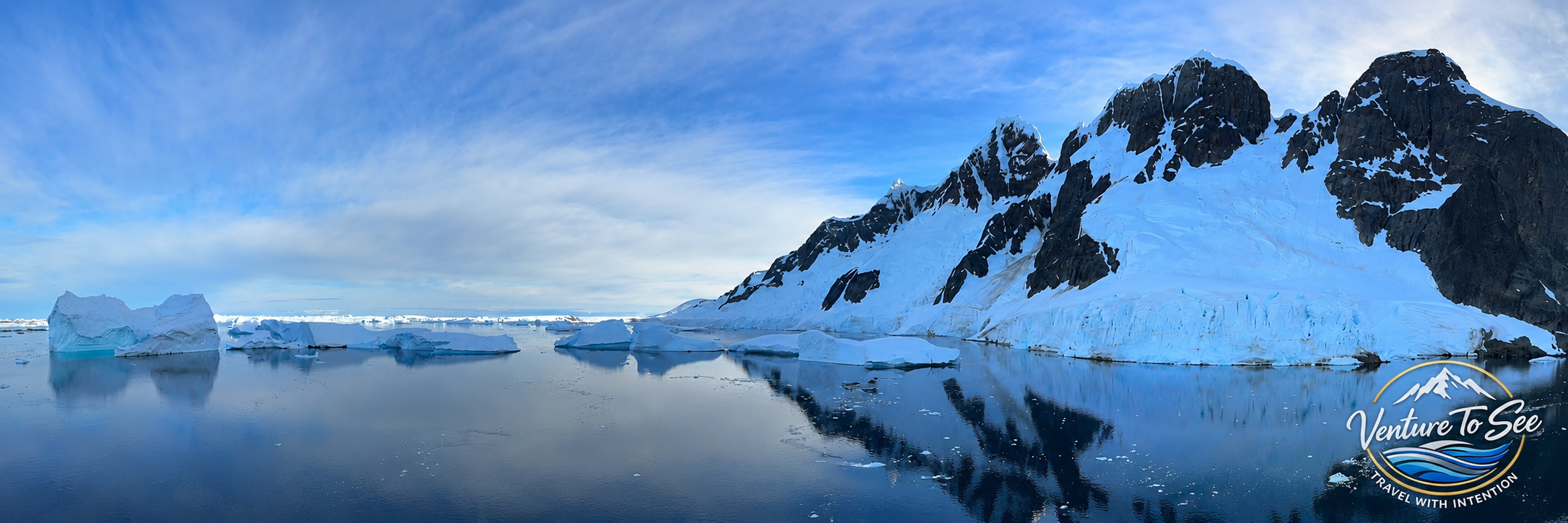
Antarctica
No permanent human population. No government. No roads. Antarctica is the only continent on Earth that belongs to no nation and has never been colonised — a place where 70% of the world's freshwater lies locked in ice two miles deep, where emperors march through polar darkness, and where the silence is so complete you can hear your own heartbeat. This is the ultimate expedition destination.
Seasons & best months to visit
Antarctica's expedition season is the mirror image of the Northern Hemisphere calendar — December and January are the height of summer. Every month within the season delivers something unique, and the "best" month depends entirely on what you most want to witness. There is no bad time to go — only different experiences.
Early Season
The continent emerges from polar winter. Pack ice is at its greatest extent, making Zodiac navigation more dramatic. Penguins arrive at colonies and begin courtship and nest-building — blue-eyed shags display, Weddell seals pup on the ice. Snow covers the landscape in pristine white. Fewer vessels than December–February; a more isolated feel. Weather more variable but wildlife energy is electric with the arrival of spring.
Peak Season
The pinnacle of Antarctic expedition travel. Continuous daylight — 20+ hours of usable light per day. Penguin chicks hatch and grow rapidly through December and January. Humpback and minke whales arrive to feed on krill blooms. Leopard seals patrol penguin colonies. Temperatures at their mildest (−2°C to +5°C on the Peninsula). The greatest variety of wildlife activity concentrated into these three months. January is the peak of activity — chicks large, whales abundant, weather most settled.
Late Season
Autumn approaches. Penguin chicks begin moulting and fledging — their grey down replaced by adult plumage. Whale activity remains high as animals feed intensively before migration. The landscape begins to change — subtle golden light replaces the harsh midday sun of January. Fewer passengers than peak season; some of the most atmospheric photography of the year occurs in March's soft, low-angle light. A compelling choice for photographers and experienced expedition travellers.
Off Season
Antarctica closes entirely to expedition cruising. Sea ice expands rapidly from March — by June the continent is surrounded by 20 million km² of pack ice. Temperatures on the plateau plunge to −60°C or below. The only humans present are scientists at permanent research stations. Emperor penguins are in the interior, incubating eggs through the polar night in conditions of extraordinary severity. No expedition access; no exceptions.
Antarctic Peninsula
The long finger of land reaching toward South America hosts the majority of all expedition visits. The Peninsula's western coast — sheltered by islands and hosting the highest concentration of penguin colonies — is the heartland of Antarctic tourism. Lemaire Channel (the "Kodak Gap"), Paradise Bay, and the Neumayer Channel offer some of the most dramatic ice and mountain scenery on Earth. Accessible via the Drake Passage from Ushuaia in 36–48 hours.
South Georgia Island
Not geographically part of Antarctica but the cornerstone of any extended sub-Antarctic voyage. Approximately 100 million seabirds nest on South Georgia — including 400,000 king penguins at Salisbury Plain, the world's largest wandering albatross colony at Bird Island, and tens of thousands of southern elephant seals and Antarctic fur seals. Shackleton's grave at Grytviken. The most extraordinary wildlife island on the planet. Requires a longer itinerary — 18–21 days minimum from Ushuaia.
Weddell Sea
The frozen ocean east of the Antarctic Peninsula — the site of Shackleton's Endurance disaster (1915) and the location of the wreck, found in 2022 at 3,008m depth. Emperor penguin colonies at Snow Hill Island and Gould Bay are accessible by helicopter from ice-strengthened vessels in October–November. The Weddell Sea's pack ice holds icebergs of extraordinary scale — tabular bergs the size of small islands. Requires the most capable vessels and a willingness to adapt entirely to ice conditions.
Lemaire Channel
An 11km channel between Booth Island and the Antarctic Peninsula mainland — 1.6km wide at its narrowest, flanked by 900m mountain faces reflected perfectly in still black water. Called the "Kodak Gap" by early expeditioners for obvious reasons. Navigating the Lemaire in early morning before wind disturbs the reflections — with humpback whales surfacing alongside the vessel — is one of the defining experiences of Antarctic expedition cruising. Blocked by ice in early November; typically open from late November through March.
Deception Island
A flooded volcanic caldera with a narrow opening (Neptune's Bellows) that allows vessels to sail inside the crater. The interior bay — Port Foster — is a ghost landscape of abandoned whaling stations, rusted boilers, volcanic black sand, and a chinstrap penguin colony. Geothermal heat warms the beach — a surreal swimming opportunity in Antarctic waters. The most recent eruption in 1970 destroyed the Chilean and British research stations on the island. Volcanically active; eruption monitoring is continuous.
Ross Sea
The most remote and least-visited region of Antarctica — accessible only by the longest expedition voyages (25–30 days from New Zealand or Tasmania). The Ross Sea is the most pristine large marine ecosystem on Earth, designated a Marine Protected Area in 2016. McMurdo Sound, the Ross Ice Shelf (the world's largest floating ice mass — the size of France), Cape Royds (Shackleton's hut, 1907), and Cape Evans (Scott's hut, 1910) are the landmarks of the heroic age of exploration. For serious expedition travellers only.
Monthly weather patterns
Data reflects the Antarctic Peninsula region (64–65°S) — the destination for the vast majority of expedition voyages. Conditions on the Peninsula are dramatically milder than the continental interior. The Weddell Sea, Ross Sea, and high-latitude interior are significantly colder. All conditions should be verified with your operator before departure.
| Month | Air Temp (°C) | Sea Temp (°C) | Daylight | Precipitation | Sea Conditions | Season |
|---|---|---|---|---|---|---|
| November | −5 to +2°C | −1 to +1°C | 18–20 hrs | Snow/sleet, 30mm | Moderate — ice variable | Early season |
| December | −2 to +5°C | 0 to +2°C | 20–24 hrs | Rain/snow, 35mm | Calm–Moderate | Peak |
| January | −1 to +6°C | 0 to +3°C | 20–22 hrs | Rain/snow, 38mm | Calm–Moderate | Peak |
| February | −2 to +5°C | 0 to +2°C | 16–20 hrs | Rain/snow, 35mm | Calm–Moderate | Peak |
| March | −5 to +2°C | −1 to +1°C | 12–16 hrs | Snow, 28mm | Moderate — ice forming | Late season |
The Drake Passage — the world's most famous ocean crossing
Between the southern tip of South America (Cape Horn, 55°S) and the South Shetland Islands (62°S) lies 800km of open Southern Ocean where no landmass interrupts the circumpolar flow of wind and water. The Drake Passage averages 36–48 hours of transit each way — and it lives up to its reputation. Swells of 4–8m are routine; Force 8–10 gales occur on roughly one in three crossings. The "Drake Lake" (an unusually calm crossing) does happen — but cannot be predicted. Seasickness medication is not optional. The passage is also extraordinarily productive for wildlife: albatross species, petrels, and cape petrels typically join the vessel within hours of leaving Ushuaia. The Drake is not a obstacle to Antarctica — it is the beginning of the experience.
Wildlife by month
Antarctica's wildlife calendar is tightly compressed into the five-month expedition season. The key events — penguin courtship, hatching, chick-rearing, fledging — cascade through the season in a predictable sequence. The month you choose determines which chapter of that story you witness. Every month is extraordinary; none is the same.
| Species | Nov | Dec | Jan | Feb | Mar |
|---|---|---|---|---|---|
| Chinstrap PenguinPygoscelis antarcticus | ★ | ★ | ★ | ● | ◌ |
| Gentoo PenguinPygoscelis papua | ★ | ★ | ★ | ★ | ● |
| Adélie PenguinPygoscelis adeliae | ★ | ★ | ★ | ● | ◌ |
| Macaroni PenguinEudyptes chrysolophus | ● | ★ | ★ | ● | ◌ |
| King PenguinAptenodytes patagonicus | ● | ★ | ★ | ★ | ● |
| Humpback WhaleMegaptera novaeangliae | ◌ | ● | ★ | ★ | ● |
| Minke WhaleBalaenoptera bonaerensis | ◌ | ● | ★ | ★ | ● |
| OrcaOrcinus orca | ◌ | ● | ★ | ★ | ● |
| Leopard SealHydrurga leptonyx | ● | ★ | ★ | ★ | ● |
| Weddell SealLeptonychotes weddellii | ★ | ★ | ● | ● | ● |
| Crabeater SealLobodon carcinophaga | ● | ● | ★ | ★ | ● |
| Southern Elephant SealMirounga leonina | ◌ | ● | ● | ★ | ★ |
| Wandering AlbatrossDiomedea exulans | ● | ★ | ★ | ● | ● |
| Antarctic PetrelThalassoica antarctica | ★ | ★ | ★ | ● | ◌ |
| Snow PetrelPagodroma nivea | ● | ★ | ★ | ● | ◌ |
Cruise operator tips
Antarctica's remoteness and environmental sensitivity demand operators who are members of IAATO (International Association of Antarctica Tour Operators) — the industry's self-regulatory body whose rules go significantly further than Antarctic Treaty requirements. IAATO membership is not a guarantee of quality, but its absence is an absolute disqualifier. Beyond that, the distinction that matters most is passenger count and ship class.
Small Expedition Class
The optimal Antarctica experience. IAATO limits landings to 100 people ashore at any one site simultaneously — a vessel carrying 100 or fewer passengers means everyone is ashore at the same time, every landing, every day. No waiting on board while other groups cycle through. Maximum flexibility to respond to wildlife opportunities. The most intimate, naturalist-led experience available. Ice-strengthened hulls (PC5–PC6) standard.
- Quark Expeditions — Ultramarine, World Explorer, Ocean Adventurer
- Aurora Expeditions — Greg Mortimer, Sylvia Earle
- Lindblad / National Geographic — Endurance, Resolution
- Hurtigruten / HX Expeditions — selected Antarctic deployments
- One Ocean Expeditions — RCGS Resolute
Mid-Size Expedition
Rotating shore parties in groups of 100 — meaning not everyone is ashore simultaneously and landing windows per group are shorter. Still IAATO-compliant with dedicated naturalist teams and genuine expedition programming. HX Expeditions' Roald Amundsen and MS Fridtjof Nansen (up to 490 passengers) are PC6 rated and carry strong expedition credentials. Silversea's Silver Endeavour combines PC5 capability with ultra-luxury. A genuine expedition experience with greater cabin comfort.
- HX Expeditions — Roald Amundsen, MS Fridtjof Nansen (PC6, up to 490 pax)
- Silversea — Silver Endeavour, Silver Cloud (luxury expedition)
- Seabourn — Venture, Pursuit (PC6)
- Scenic — Scenic Eclipse I & II (PC6)
- Ponant — Le Commandant Charcot, Le Boréal
Large Cruise Ships
IAATO prohibits vessels carrying more than 500 passengers from making any shore landings in Antarctica. These vessels — operated by large cruise lines — offer scenic cruising and Drake Passage crossings but no Zodiac excursions and no contact with the continent. A categorically different experience. If landings are important to you, a vessel with more than 500 passengers is not an expedition cruise — regardless of how it is marketed.
- No shore landings permitted under IAATO rules above 500 pax
- Scenic cruising only — no Zodiac operations
- Significantly lower cost than expedition vessels
- Not a genuine Antarctic expedition experience
Classic Antarctic Peninsula
The benchmark Antarctica expedition — departing Ushuaia and crossing the Drake Passage (36–48 hours each way) to the Antarctic Peninsula. Typically visits 5–8 landing sites including penguin colonies (chinstrap, gentoo, Adélie), historic huts (Port Lockroy, 1944), the Lemaire Channel, Paradise Bay, and the South Shetland Islands. Multiple Zodiac cruises per day. 4–5 full days in Antarctic waters. The most cost-efficient introduction to the continent and the gateway experience for most first-time Antarctic visitors.
South Georgia & Falkland Islands
The extended voyage that most serious wildlife travellers ultimately regard as the finest expedition available — combining the Antarctic Peninsula with South Georgia (king penguins, wandering albatross, elephant seals, Shackleton's grave) and the Falkland Islands (rockhopper and Magellanic penguins, striated caracaras, black-browed albatross). The wildlife density of South Georgia — 100 million seabirds on a single island — is unmatched anywhere on Earth. Requires 18–21 days and significant additional investment. Justifies every penny.
Fly-Cruise (Punta Arenas → King George Island)
Eliminates the Drake Passage entirely — a charter flight from Punta Arenas deposits passengers on King George Island (South Shetlands) directly, connecting to the expedition vessel for a full week in Antarctic waters. The fly-cruise is ideal for those with severe seasickness concerns or time constraints. The trade-off: the Drake Passage crossing is itself a spectacular wildlife experience — petrels, albatross, and the first iceberg sighting are among the defining moments of a traditional Antarctic voyage.
Weddell Sea & Ross Sea
The most demanding and least-visited Antarctic itineraries — requiring the most capable vessels, the longest time commitment, and the greatest flexibility of any expedition traveller. The Weddell Sea offers pack-ice navigation, potential emperor penguin encounters (with helicopter access to Snow Hill Island), and the 2022 Endurance wreck site. The Ross Sea — most easily accessed from New Zealand — visits the historic huts of Scott and Shackleton, the Ross Ice Shelf, and the most pristine marine ecosystem remaining on Earth. These voyages sell out years in advance.
The 100-person landing rule
IAATO mandates that no more than 100 passengers may be ashore at any visitor site simultaneously. This single rule drives the entire structure of Antarctic expedition cruising — and is the primary reason why vessel size matters so profoundly. Vessels with fewer than 100 passengers provide categorically better access than those with more.
Book 12–18 months ahead
Peak season departures (January) on quality small-ship operators sell out 12–18 months in advance. November and March offer more availability and lower prices — with genuinely different and compelling wildlife experiences. Contact operators in January for the following season's November–March window.
Ushuaia — the gateway city
Most Antarctic expedition cruises depart from Ushuaia, Argentina (Malvinas Argentinas International Airport, USH) — fly via Buenos Aires (Aeroparque/AEP). Build in at least one pre-voyage night in Ushuaia for weather delays. The city has excellent gear shops if you've forgotten anything critical, and the Museo del Fin del Mundo is excellent preparation.
Travel insurance — non-negotiable
Medical evacuation from Antarctica costs USD $50,000–200,000+. Most operators require documentation of a minimum $100,000–500,000 evacuation coverage before boarding. Standard travel insurance is insufficient — you need a policy that explicitly covers polar regions and adventure activities. Obtain this before paying any deposit.
Packing essentials
Antarctica is the most demanding packing destination in this guide series — wind chill in the Peninsula regularly drives felt temperature to −20°C even in midsummer, Zodiac crossings produce constant salt spray, and UV intensity off ice and water is extreme. The good news: HX Expeditions and most quality operators provide the expedition parka and rubber boots. What you layer underneath is your responsibility.
Base & insulation layers
- Merino wool base layer tops × 3 (250–260gsm — heavyweight)
- Merino wool base layer bottoms × 2
- Heavyweight synthetic insulated jacket — synthetic not down (wet resistance critical in constant spray)
- Heavy fleece (300wt Polartec) × 2
- Lightweight fleece for layering
- Merino wool socks × 8–10 pairs minimum
- Down vest for on-board warmth between landings
Outer waterproof layer
- Operator-provided expedition parka — confirm before purchasing your own
- Waterproof bib salopettes — bib prevents spray entry at the waist in rough Zodiac crossings
- Operator-provided rubber knee boots — confirm sizing in advance
- Waterproof gaiters for penguin colony landings (guano is everywhere)
- Dry bags × 2 (10L + 20L) for camera gear in Zodiacs
Extremities — critical
- Waterproof over-mitts — non-negotiable in Antarctic wind chill
- Thin liner gloves × 4 pairs (wool or synthetic for camera operation)
- Heavyweight fleece gloves × 2 pairs
- Balaclava × 2 — always one dry
- Warm hat × 2 (heavyweight wool)
- Neck gaiter × 2
- Category 3–4 polarised sunglasses — ice UV causes snow blindness rapidly
- SPF 50+ sunscreen & SPF lip balm — UV reflection off ice is severe even at −5°C
Photography kit
- Telephoto zoom (100–500mm) — leopard seals, whale flukes, distant penguin colonies
- Wide-angle zoom (16–35mm) — icescape scale demands it; nothing else captures a 200m tabular berg
- Waterproof rain sleeve — constant salt spray in Zodiacs
- Spare batteries × 6 minimum — cold kills charge within 20 minutes; rotate from inner pockets
- Chemical hand warmers × large supply to keep batteries warm
- Memory cards 512GB+ total — iceberg and penguin chick encounters justify high-volume shooting
- Polarising filter for iceberg blue tones
- Silica gel packets to prevent condensation on warming
Footwear & hiking
- Waterproof insulated hiking boots rated to −20°C minimum — for trekking ashore on volcanic rock and snow
- Neoprene boot liners for extreme cold operations
- Trekking poles — penguin colony terrain is uneven and slippery with guano
- Operator-provided rubber knee boots for all wet landings (Zodiac step-outs in the shallows)
Health & essentials
- Travel insurance with polar medical evacuation — USD $500,000 minimum; document before boarding
- Seasickness medication — Drake Passage is serious; consult your doctor for prescription options (scopolamine patch is most effective)
- Personal prescriptions × 3× supply — no pharmacies south of Ushuaia
- Binoculars 10×42 — whale and iceberg scanning from deck is a daily discipline
- Power bank 20,000mAh (cold drains devices rapidly)
- Silica gel packets — humidity from ocean spray damages electronics
- Antarctica: An Encyclopedia — John Stewart (definitive reference)
- The Worst Journey in the World — Apsley Cherry-Garrard (essential pre-voyage reading)
Photography tips
Antarctica is simultaneously the most photogenic and most technically demanding environment in which most expedition photographers will ever work. The combination of extreme cold, constant salt spray, blinding ice glare, and extraordinary wildlife at close range demands both preparation and discipline. The images available here — penguins backlit against a calving glacier, an orca breaking the surface at a tabular berg — are simply not available anywhere else on Earth.
Working in extreme cold
Lithium batteries lose 40–60% of capacity at −10°C and can fail completely at −20°C with wind chill. Carry 6+ batteries and rotate them constantly from inner pockets against your body. When returning to the warm ship interior, seal your camera in a dry bag before entering — allow 30 minutes of gradual warming before opening to prevent condensation on the sensor. A cold camera in a warm, humid interior will collect moisture on every surface. Silica gel packets in the bag absorb this moisture. Never leave a camera on a cold surface in the ship — the temperature differential creates interior condensation.
Exposing for ice and snow
Antarctica's omnipresent white — snow, ice, and cloud — fools camera metering systems into underexposure. Your histogram will show data clustered left when it should be right. As a rule, add +1 to +2 stops of exposure compensation when shooting in snow or ice environments — check the histogram after every 5–10 shots and adjust. Polarising filters are essential for cutting the surface glare on sea ice and deepening the extraordinary blue of glacial ice. Shoot RAW exclusively — the recovery latitude in post-processing for Antarctic light is enormous.
Penguin colony technique
The key to compelling penguin images is patience and eye level — lie in the snow (your salopettes are waterproof) and wait for behaviour rather than chasing static birds. The most powerful images show specific interactions: a chick aggressively food-begging a parent, two adults engaged in mutual preening, a bird returning from the sea to its nest with guano-stained feet. Use 200–400mm for individual portraits; go wide (24–35mm) for colony-scale environmental shots. The sound of 100,000 penguins is itself an extraordinary dimension — let it inform your patience.
Icebergs — light and scale
Icebergs reward patient observation over hours rather than a single approach. The light on an iceberg changes minute by minute as clouds move and the sun angle shifts — a flat, uninspiring berg at noon becomes extraordinary at 2am in the amber sub-polar light. Include human scale: a Zodiac at the base of a 60m berg communicates the scale that a telephoto shot of the berg alone never can. For the blue interior of a bergy bit: overcast light eliminates the surface reflection and reveals the extraordinary aquamarine of glacially compressed ice. Shoot at water level from the Zodiac for the most dramatic perspective.
Whale photography
Antarctic humpbacks are unusually unafraid of vessels — they will approach and investigate at close range, sometimes surfacing within metres of the hull. Position at the bow for the downward-angle shot; use a 70–200mm zoom for flexibility between the wide "whale emerging beside the Zodiac" and the tight tail-fluke portrait. Shoot 1/2000s minimum for any surface action. The decisive humpback image: a full breach in front of a calving glacier. It requires pre-positioning the boat, patience, and the willingness to shoot 200 frames to get one. Orca encounters — particularly Type B orcas wave-washing seals off ice floes — are among the most dramatic wildlife events accessible to any photographer anywhere.
The midnight light
In December and January, Antarctica never gets fully dark — the sun dips to within a few degrees of the horizon at midnight and rises again immediately, producing a golden 2–4 hour period of extraordinary warm, directional light. This is the finest photographic light of the entire season — set an alarm. The midnight Lemaire Channel, lit from the north with golden light reflected in still black water, is one of the great landscape photography subjects on Earth. Most passengers are asleep. The deck is empty. The albatross circles in silence. Be there.
Conservation notes
Antarctica is governed by the Antarctic Treaty System — an extraordinary international agreement signed in 1959 that designates the continent as a scientific preserve and bans military activity and resource extraction. Tourism is regulated by IAATO under the Protocol on Environmental Protection to the Antarctic Treaty (the Madrid Protocol, 1991). The rules exist because Antarctica has no capacity to absorb the impacts that are routine in other wilderness destinations.
IAATO visitor guidelines
Every passenger receives a mandatory IAATO briefing before their first landing. The core rules: maintain 5 metres minimum distance from penguins and seals (if they approach you, hold still); never block an animal's path to the sea; take nothing, leave nothing; stay on marked routes at visitor sites; never feed or touch any wildlife; and disinfect all clothing and equipment between landings to prevent cross-contamination between sites. These are not suggestions — they are binding conditions of your expedition participation.
Biosecurity — non-negotiable
Antarctica has no native land mammals and extremely limited terrestrial flora. A single non-native seed — carried in the seam of a jacket or the tread of a boot — could establish an invasive plant species with no natural predators or competitors. Before every landing, all clothing and equipment must be vacuumed and disinfected. Your operator will run mandatory boot-washing stations at the vessel gangway. This process is not optional and not a formality — it is the most important conservation action you take on the entire voyage.
Climate change — Antarctica's crisis
The West Antarctic Ice Sheet is losing mass at approximately 150 billion tonnes per year — a rate that has accelerated threefold since the 1990s. The collapse of ice shelves (Larsen B in 2002, portions of Conger Ice Shelf in 2022) is reshaping the continent in real time. The mean air temperature on the Antarctic Peninsula has risen by 3°C since 1950 — faster than any other region on Earth. Sea ice extent is now at record lows. The glaciers you photograph in 2025 are measurably smaller than those photographed by expedition tourists in 2005. You are witnessing a system in acute crisis.
The Madrid Protocol
The Protocol on Environmental Protection to the Antarctic Treaty (1991) designates Antarctica as a "natural reserve devoted to peace and science" and prohibits any activity relating to mineral resources other than scientific research. It also requires environmental impact assessment for all activities, establishes protected areas, and mandates waste management standards for all operators. The Protocol's indefinite duration clause means it has no expiry — though its mining ban can theoretically be renegotiated after 2048. Support Antarctic and Southern Ocean Coalition (ASOC) advocacy to maintain and strengthen these protections.
Drone regulations
Drone flights in Antarctica are subject to Antarctic Treaty regulations and IAATO guidelines. Drones require specific authorisation and are prohibited near wildlife colonies — the disturbance caused by a drone overflying a penguin colony is measurable and significant (elevated heart rates, nest abandonment, chick trampling during panic responses). Most reputable operators prohibit personal drone use entirely at wildlife sites. Verify your operator's drone policy before departure — and accept any restrictions placed on personal drone use as a conservation obligation, not an inconvenience.
Choosing responsible operators
IAATO membership is the baseline minimum — but within IAATO, operators vary significantly in their environmental commitment. Look for operators who contribute to Antarctic science (citizen science programmes, seabird counts, plankton sampling), use hybrid or cleaner-fuel propulsion, offset voyage emissions, maintain strong biosecurity programmes, and support Antarctic conservation organisations. The carbon footprint of an Antarctic voyage is significant — choose an operator who acknowledges this and is actively working to reduce it. The International Antarctic Expedition community produces a disproportionate share of Antarctic conservation advocates — choose to be one.
Common questions about this expedition
Book With Confidence
We are affiliate partners with a select group of expedition and luxury cruise lines. Every recommendation is grounded in firsthand experience — we recommend these lines because we believe in what they deliver.



Help Us Make This Better
Expedition cruising is always evolving — new routes, changing conditions, better gear. If you've been on a voyage and have something to add, a correction to share, or feedback on what helped you prepare, we'd genuinely love to hear it. Every message gets read.
Send FeedbackThe clothing recommendations, packing lists, and seasonal weather information in this guide are intended as general reference only. Protective clothing requirements, mandatory gear specifications, and seasonal operating conditions vary by operator, vessel, itinerary, and year — and must be verified directly with your expedition operator prior to departure. IAATO visitor guidelines, site access regulations, and environmental protocols are updated regularly and take absolute precedence over any information presented here. Medical evacuation insurance meeting your operator's minimum requirements is mandatory and must be obtained and documented before boarding. Drake Passage and Southern Ocean conditions can be life-threatening — all safety briefings provided by your expedition team must be followed immediately and without exception. This guide does not constitute safety, medical, or legal advice.