
Standing with Sea Turtles: My Grand Cayman Shore Day Review
The Sea Trek Helmet Dive at the Cayman Turtle Centre is one of those rare excursions that actually delivers. Here's what nearly 30 years of travel taught me to look for — and why this one earned a permanent place on my highlight reel.
By Venture To See·Grand Cayman, Cayman Islands·⏱ 9 min read
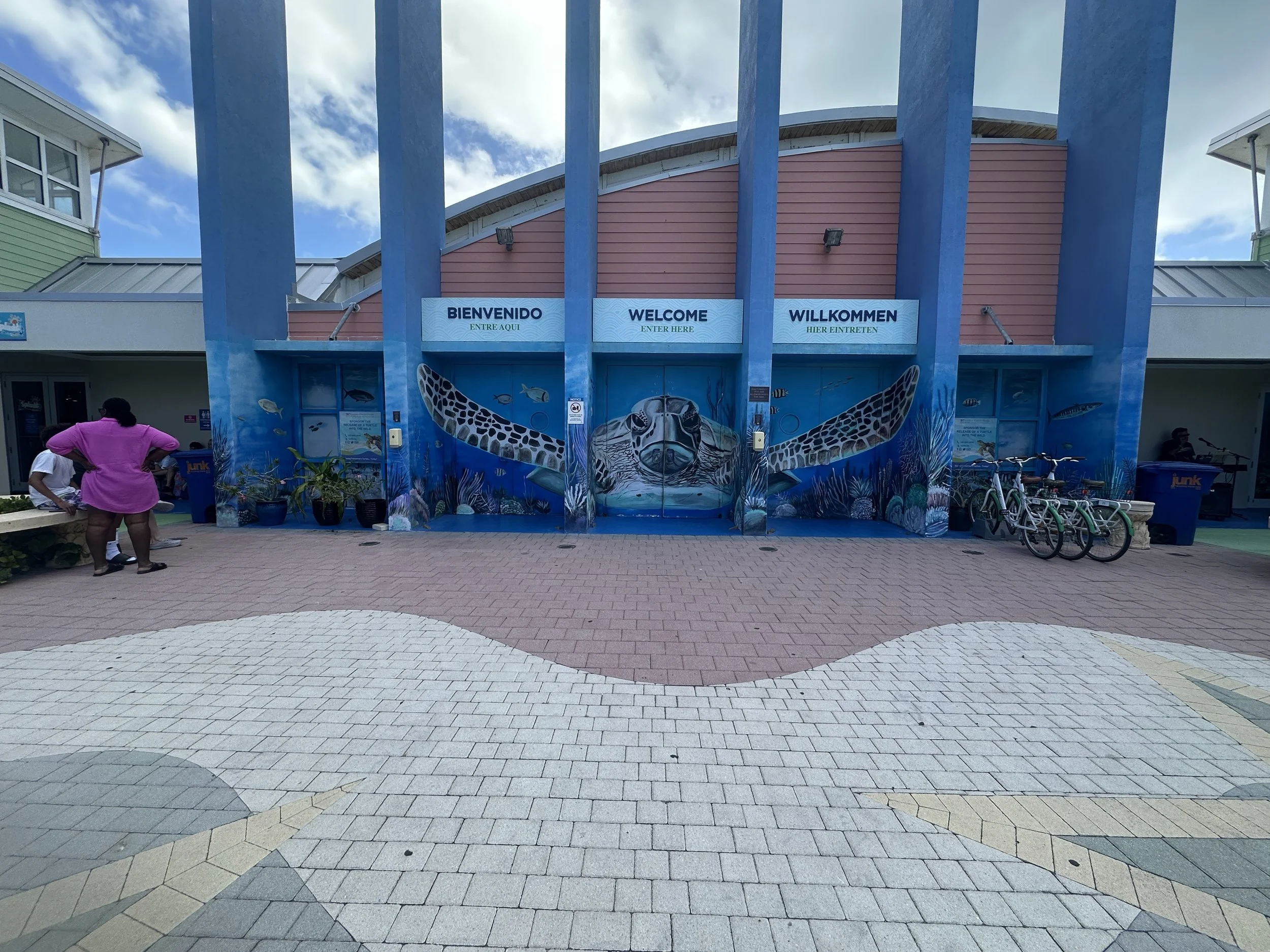
QUICK FACTS — CAYMAN TURTLE CENTRE SEA TREK
Port type: Tender port (Georgetown, Grand Cayman) — plan accordingly
Group size: Maximum 18 people per excursion — genuinely small
Helmet dive depth: Approximately 8 feet — no scuba certification needed
Active time underwater: Around 30 minutes
What to wear: Swimsuit and water shoes (Crocs available on-site up to size 12)
Return bus option: Public bus back to port runs every ~15 min, $2 per person
Ship all-aboard (reference): 5:15 PM — plenty of flexibility to extend your day
Best for: Families, older kids, first-timers, anyone wanting more than a beach chair
I have been moving through airports, cruise terminals, and unfamiliar streets for the better part of three decades. Work travel built the habit. Family travel gave it meaning. After all of that, I have developed a fairly reliable filter for what is worth doing on a shore day and what is just a way to burn four hours and come back with a magnet for your refrigerator.
The Sea Trek Helmet Dive at the Cayman Turtle Centre cleared that filter easily. Here is the full breakdown — including the parts the brochure glosses over.
Grand Cayman Is a Tender Port. Don't Underestimate That.
Georgetown does not have a cruise pier. Your ship anchors offshore and runs tenders — smaller boats — to bring passengers to land. That single logistical fact shapes your entire morning, and if you're not thinking about it the night before, you will feel it the next day.
On our sailing, Royal Caribbean began running tenders around 8:30 in the morning. Our excursion required us at the pier by 9:45, which meant getting down to the tender staging area by around 9:00. If you have booked through the cruise line, the process is built for you — you work into the tender line as groups are called. If you have booked independently, you need a tender number and you wait your turn.
PRACTICAL TIP We watched a family of four — independent booking — get told they'd need to wait for an available tender while cruise-line excursion guests moved ahead of them. At a tender port, booking through the cruise line can save real headaches when timing is tight. Factor this into your planning.
Once ashore, the pace settled. The tour operators met us at the pier, confirmed our group of 18, and we were on the bus by 10:15 or so. The drive across the island to the Turtle Centre took about 45 minutes. The driver kept things moving with some quick commentary — Seven Mile Beach, Governor's Beach, Cemetery Beach — nothing elaborate, but enough to remind you that Grand Cayman has a quiet, polished beauty before you ever get to the excursion itself.
Why 18 People Makes a Difference
The cap of 18 guests per tour is one of the first things the operators mentioned, and I appreciated it immediately. I have been on shore excursions where 40 people pile into a space designed for 20. This was not that.
Because only six people can do the helmet dive at a time, the group naturally divided into thirds. While one group was underwater, the others had real time to explore — the turtle habitats, the predator tank with large fish and sharks, the aquarium-style exhibits, the bird area, the water park section, the gift shop. It worked well. Nobody was standing around staring at their watch.
We arrived at the centre around 11:00 and were scheduled to regroup at 1:15. That gave us roughly two hours on-site. For adults and older kids focused on the dive experience, it is enough. For families with young children who would want longer in the water park or more time with the exhibits, it is worth knowing you can arrange to stay independently — more on that below.
The Turtles Before the Dive
Before anyone got in the water, the staff walked us through one of the sea turtle areas and gave us real context. They pointed out older residents — including one reportedly born in 1968 — and explained how the centre monitors egg-laying and hatchlings. The science behind what they do was laid out plainly and without performance.
That part of the visit mattered more than I expected. It reframed the whole experience. You were not just there to get a photo. You were being introduced to animals that have been in someone's careful care for decades.
The Helmet Dive: What It Actually Feels Like
Sea Trek is not scuba. You do not need any certification, and you do not need to be an especially confident swimmer. The dive area is about eight feet deep — shallow enough to stand on the bottom comfortably, deep enough to feel genuinely submerged.
The setup goes like this: you wear a metal frame harness on your back on shore. Once you are in the water and positioned, the staff lowers the helmet down onto your shoulders. On land, the helmet is heavy. In the water, that weight vanishes almost entirely. Air is pumped in continuously from above. You breathe normally. You walk along the bottom.
"Once the turtles started moving around me — gliding past at eye level, unhurried, completely at ease — the weight of the helmet, the logistics of the morning, all of it disappeared."
For me, this was the first time I'd been fully underwater without relying on a snorkel. That alone made it feel different. But the real shift came from the turtles themselves. There were maybe half a dozen, roughly the size of a pizza box each, moving through the water around us with an ease that made the whole scene feel calm rather than chaotic. Fish drifted through too. Once you settle into the rhythm of breathing and walking along the bottom, the experience becomes surprisingly meditative.
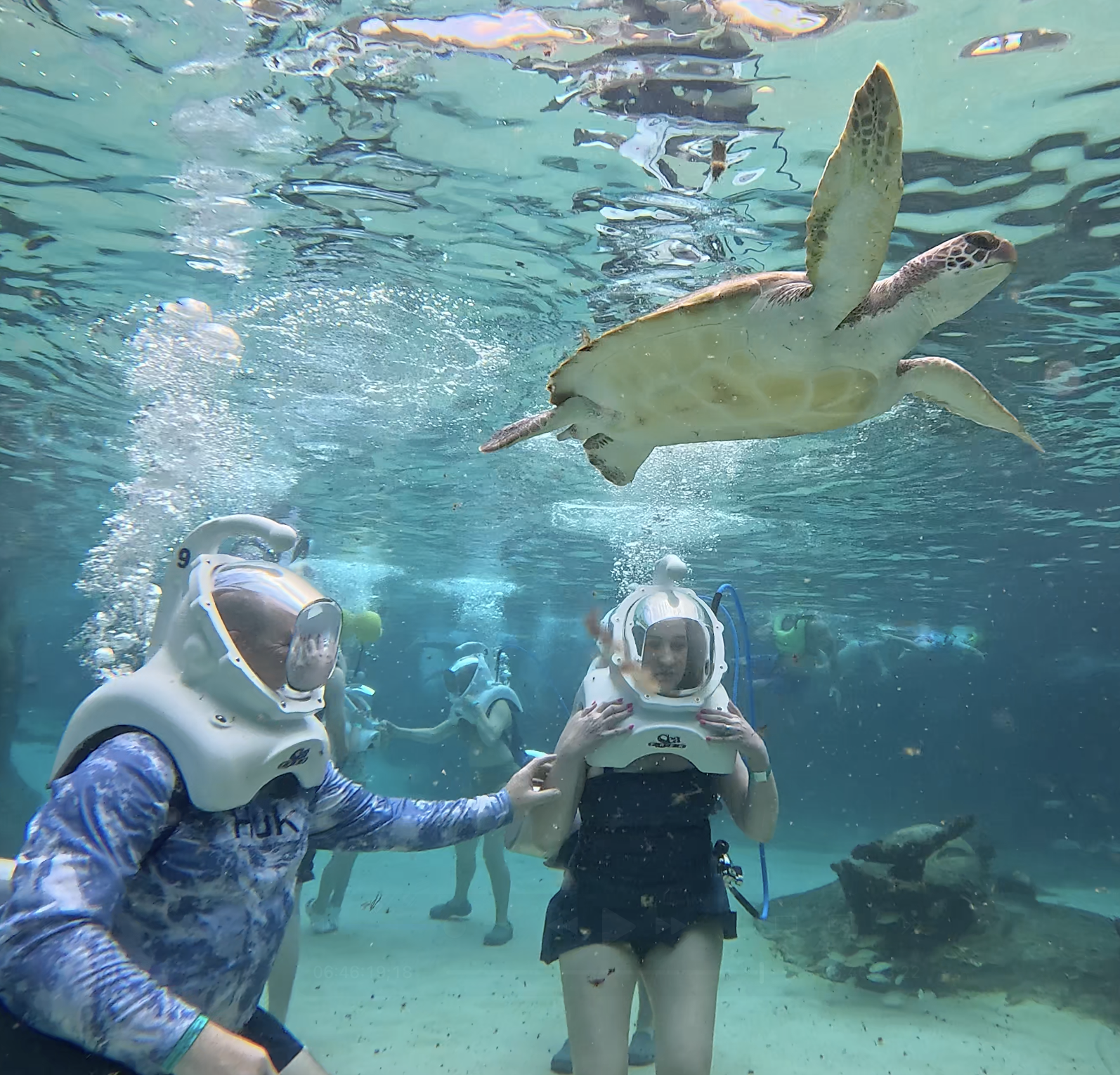
We spent about 30 minutes underwater. That is the right amount of time. Not so short that you feel rushed, not so long that the novelty wears off.
A Detail I Genuinely Appreciated: Hands-Free Photos
The guides handle all the photography while you're underwater. That sounds like a small thing until you realize what it means: your attention is fully free. No fumbling with a waterproof case. No splitting focus between the moment and the shot. You simply look around and take it in.
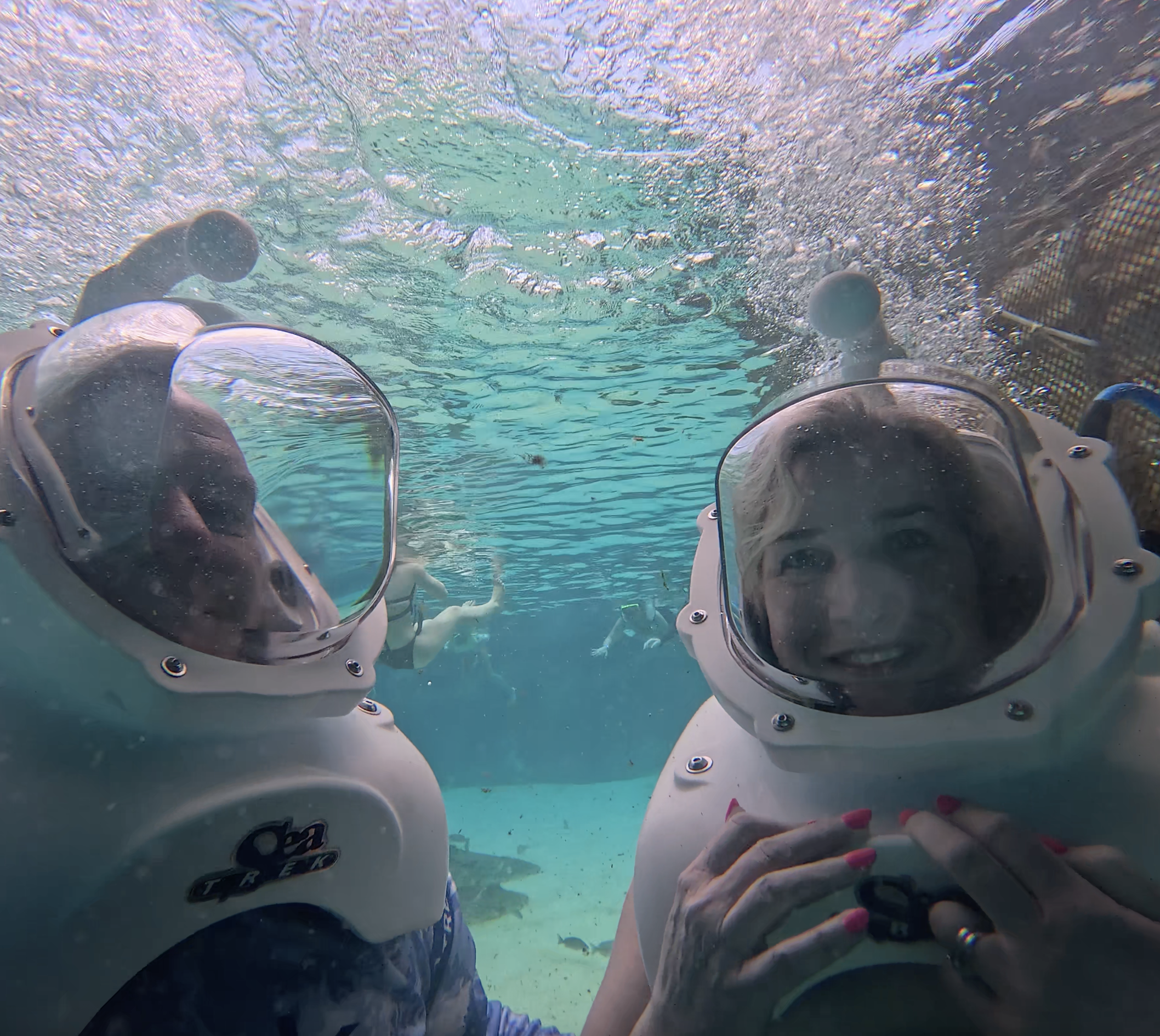
There were snorkelers in the lagoon during the helmet dive, so it is not a private space — but in practice, once you are down there with the turtles, the lagoon might as well not exist.
Flexibility at the End of the Day
This is worth knowing ahead of time. The ship's all-aboard was not until 5:15 in the evening, and the tour operators told us clearly that anyone who wanted to stay longer could sign a release and make their own way back. The public bus runs past the Turtle Centre — and the Dolphin Centre directly across the street — roughly every 15 minutes. Fare is $2 per person.
We left about 45 minutes before the scheduled return and caught the public bus back. Three of us, six dollars total, quick ride, a little more island scenery. It was a genuinely good bonus to the day.
FAMILIES WITH YOUNGER KIDS — READ THISThe water park section, the shark tank, and the bird area could easily fill another hour or two for children who want more time to explore. Budget for that. Talk to the operators when you arrive, sign the release, and use the public bus. The infrastructure supports it.
What Grand Cayman Looks Like Beyond the Excursion
We had time after returning to walk around the port area before heading back to the ship. Grand Cayman's port shopping district is clean, well-organized, and unmistakably Caribbean-cruise in character — plenty of stores, plenty of friendly sales pressure, and not much that is genuinely distinctive if you have done a few of these ports.
That is not a criticism so much as an observation. Grand Cayman, for a cruiser, is a port that rewards the traveler who has a plan. If your plan is a quality shore excursion, the day delivers. If your plan is to wander and see what happens, you may find yourself back on the ship before lunch.
Would I Do This Again?
Yes. Specifically for younger family members — kids, grandkids — I would do this first and build the day around it. The combination of the educational component, the helmet dive, and the tactile experience of being around the turtles makes it the kind of excursion that gives children something real to hold onto long after the cruise is over.
For adults traveling without children, it still holds up. The underwater experience is genuinely unlike most things you will do on a Caribbean port day. It is not adrenaline. It is something quieter — which, at a certain point in your travel life, becomes more valuable, not less.
The Verdict — From Someone Who's Seen Enough Shore Days to Know the Difference
The Sea Trek Helmet Dive at the Cayman Turtle Centre is one of the
To add a colored background behind the text box containing the headline "The Verdict — From Someone Who's Seen Enough Shore Days to Know the Difference", use one of these common methods depending on your environment.
HTML/CSS (for web pages)
Wrap the headline in an element and style its background:
The Verdict — From Someone Who's Seen Enough Shore Days to Know the Difference
.headline { background-color: #f2f2f2; /* choose any color */ padding: 12px 16px; /* space between text and box edges */ display: inline-block; /* shrink to text width; use block for full width */ border-radius: 6px; /* optional rounded corners */ color: #222; /* text color for contrast */ font-weight:
more honest shore excursions I have done in the Caribbean. The small group size is real. The educational component has substance. The underwater experience with the turtles is something you will remember. And the logistics — while not invisible — are manageable if you go in prepared.
Understand the tender process. Pack water shoes. Know your flexibility window at the end of the day. Do those three things, and this excursion will be the story you tell when someone asks how your cruise was.
★★★★☆ — Highly Recommended
Frequently Asked Questions
The questions I would have wanted answered before booking — straight answers, no filler.
Do you need to know how to swim to do the Sea Trek helmet dive at the Cayman Turtle Centre?
No swimming ability is required. The Sea Trek helmet dive takes place in water that is approximately eight feet deep, and you walk along the bottom rather than swim. Air is continuously pumped into the helmet, so you breathe normally the entire time. Staff are in the water with you at all times. It is one of the more accessible underwater experiences available to cruise passengers — suitable for non-swimmers and people who would not consider themselves ocean-comfortable.
Is the Cayman Turtle Centre Sea Trek worth it for adults without children?
Yes — though it hits differently than a family experience. The helmet dive itself is genuinely immersive: standing on the bottom of a lagoon with sea turtles moving around you at eye level is not something you replicate with a snorkel or a glass-bottom boat. The educational component about the centre's conservation work also adds real substance for adults who want more than just a photo opportunity. If you are choosing between this and a beach chair day, this wins on depth of experience — literally and otherwise.
Is the Cayman Turtle Centre Sea Trek worth it for adults without children?
Yes — though it hits differently than a family experience. The helmet dive itself is genuinely immersive: standing on the bottom of a lagoon with sea turtles moving around you at eye level is not something you replicate with a snorkel or a glass-bottom boat. The educational component about the centre's conservation work also adds real substance for adults who want more than just a photo opportunity. If you are choosing between this and a beach chair day, this wins on depth of experience — literally and otherwise.
How does the tender process work at Grand Cayman, and how does it affect my excursion timing?
Grand Cayman (Georgetown) is a tender port, meaning your ship anchors offshore and runs smaller shuttle boats to bring passengers ashore. If you have booked a shore excursion through the cruise line, you are typically called into the tender line as a group and given priority access. If you have booked independently, you will need a tender number and wait your turn — which can add meaningful time to your morning, especially on busy port days. For any excursion with a firm start time, arriving early to the tender staging area is essential. Plan to be in position at least 45 to 60 minutes before your required pier arrival time.
What should I wear and bring to the Sea Trek helmet dive?
Wear a swimsuit. Bring water shoes — the turtle swim area has a textured bottom that is easier to navigate with something on your feet. If you forget water shoes, the Cayman Turtle Centre has Crocs available on-site; the largest size available was a men's 12 when we visited, so larger-footed travelers should plan ahead. Leave valuables and anything you do not want wet on the bus or in a locker. The guides handle all in-water photography, so you do not need to bring a camera or waterproof case.
How long is the actual time in the water during the Sea Trek dive?
Approximately 30 minutes underwater. Because the excursion limits participants to six people per dive session and the total group size is capped at 18, the time is organized into three rotations. While you wait for your turn, there is genuinely plenty to explore at the facility — turtle exhibits, a predator tank, aquarium displays, a bird area, a water park, and a gift shop. The wait does not feel idle.
Can I stay longer at the Cayman Turtle Centre after the excursion ends?
Yes. The tour operators allow guests to sign a release and remain at the centre independently after the group departs. Getting back to the port is straightforward: a public bus runs past the Cayman Turtle Centre roughly every 15 minutes and costs $2 per person. The Dolphin Centre sits directly across the street, so there are two attractions in one location if you want to extend your day significantly. Just confirm the ship's all-aboard time before making this decision — and leave yourself ample buffer.
Is the Cayman Turtle Centre Sea Trek appropriate for children?
It is one of the better family-oriented excursions available in Grand Cayman for older children and teenagers. The helmet dive is accessible without swimming ability, the educational component about sea turtle conservation is engaging rather than dry, and the centre has a water park, animal exhibits, and other areas that extend the value of the visit beyond the dive itself. For very young children, the two-hour tour window may feel compressed — particularly if they want more time in the water park. If traveling with young kids, consider arriving at the centre with a plan to stay longer independently using the public bus option.
Is it better to book the Sea Trek excursion through the cruise line or independently?
For Grand Cayman specifically, the tender port dynamic makes cruise-line booking worth serious consideration. The main advantage is tender priority — cruise-line excursion guests move into the tender line as groups are called, while independent bookers wait for an available tender, which can cost meaningful time on a tight morning. If you miss your excursion start time because of tender delays, a cruise-line booking is typically protected; an independent booking is not. If the excursion timing is flexible or your ship's tender process is well-managed, independent booking may still work — but know the risk going in.
Thank You for reading along. Follow along for more travel adventures @venturetosee.
