Cozumel, Mexico · Celebrity & Royal Caribbean Shore Excursion · Trip Story
Chichen Itza from Cozumel: A Pyramid That Chirps, the Great Ball Court, and Celebrity's Small-Group VR Tour
We'd already seen Tulum, so we figured we knew what Mayan ruins looked like. We were wrong. Here's what a small group, a good guide, and one handclap taught us.
Disclosure: Some of the links in this post are affiliate links. If you click through and book a tour or experience, we may earn a small commission — at no additional cost to you.
We'll start with a confession. We thought we'd already done the Mayan ruins thing. A few cruises back we toured Tulum, the walled city on the cliffs over the Caribbean, and we walked away figuring we had the general idea. Old stones, great view, box checked.
Chichen Itza was different. It's the big one, one of the New Seven Wonders of the World, so when our Celebrity Constellation sailing put us in Cozumel, we booked the small-group excursion Celebrity calls "Destination Highlight: Explore Chichen Itza Ruins with VR." It's also offered on Royal Caribbean sailings. We'll tell you up front: it's a long day, and it was worth it. We came home with three things stuck in our heads. A pyramid that chirps back when you clap. A ball court where you can hear someone at the far end. And Kukulkán, the feathered serpent, who shows up just about everywhere once someone points him out. But what really stuck with us was how well preserved it all is. After a thousand years, you can still make out faces, feathers, and serpents carved in the stone.
The Day at a Glance
Getting There: A Long Morning, Well Spent
We docked in Cozumel at 7:00 a.m. Most of the ship was still in line for coffee when our group met in the theater on the Constellation.
There were twelve of us. That's the first thing we'd tell anyone comparing tours. A lot of Chichen Itza trips run full-size buses of 50 or 60 people, and anyone who's done a big-bus tour knows how that goes. You spend half the day waiting on the slowest person and the other half trying to hear the guide. Twelve people fit in a half circle around one guide, and everybody gets their questions answered.
Getting there takes some effort. First a 45-minute ferry from Cozumel to Playa del Carmen. The water was smooth, thankfully. Then about two and a half hours in a van heading inland across the Yucatán, with no bathroom stop. More on that in the tips.
Our guide was Victor. As part of his college studies, he spent a year living in a town filled with descendants of the Maya. You could tell. He told us his Maya name, and he showed us a couple of pieces of jewelry he was given during that year, explaining the symbolism behind each one. He didn't talk about ruins. He talked about a city and the people who lived in it, like he'd met a few of them. In a way, he had.
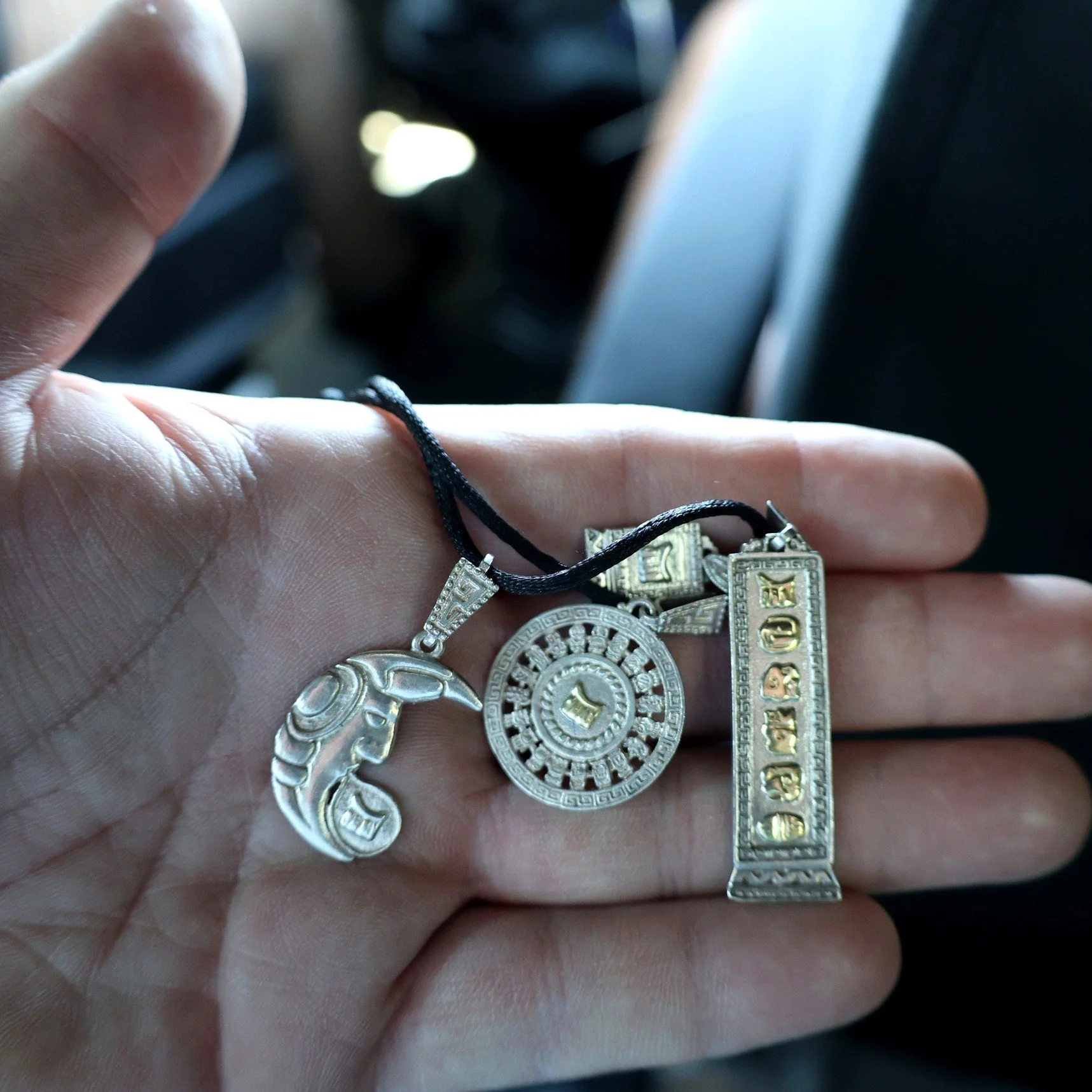
Maya symbols in silver: a crescent moon face, a calendar wheel, and a column of glyphs.
So Where's the "VR"?
Let's clear this up, because the name had us picturing goggles. There are no headsets. Each of us got a Samsung tablet loaded with about 200 images: reconstructions, diagrams, photos of the site when it was first rediscovered, and drawings of how the temples were probably painted. Victor would have us pull up a picture, and you'd look from a gray stone wall to the screen and see the same wall in color. Pretty low-tech, honestly. It worked better than goggles would have.
He used the drive to set up the big idea. The Maya built for the sky. Their calendar was remarkably accurate, and their buildings line up with the sun, the solstices, and the equinoxes. By the time we parked, we knew what we were looking for. That's more than we can say for most bus rides.
From Cozumel, It's a Shore Excursion
Book a Celebrity or Royal Caribbean Sailing with a Cozumel Stop
From Cozumel, the only way to Chichen Itza is your cruise line's shore excursion. We took Celebrity's small-group tablet tour, and it's also offered on Royal Caribbean sailings. We'll help you find a sailing that stops in Cozumel and get the excursion lined up.
Start Planning Your Cruise →El Castillo: A Calendar Built in Stone
The entrance was busy. Vendors lined the walkway selling hats and souvenirs, and everyone shuffled the same direction toward the main plaza. Then the trees open up and there it is.
Victor did a great job walking us through each of the highlights, in order: El Castillo and its acoustics first, then the Temple of the Warriors, the cremation area, and the Great Ball Court, finishing with a mask-making demonstration. We'll take them the same way.
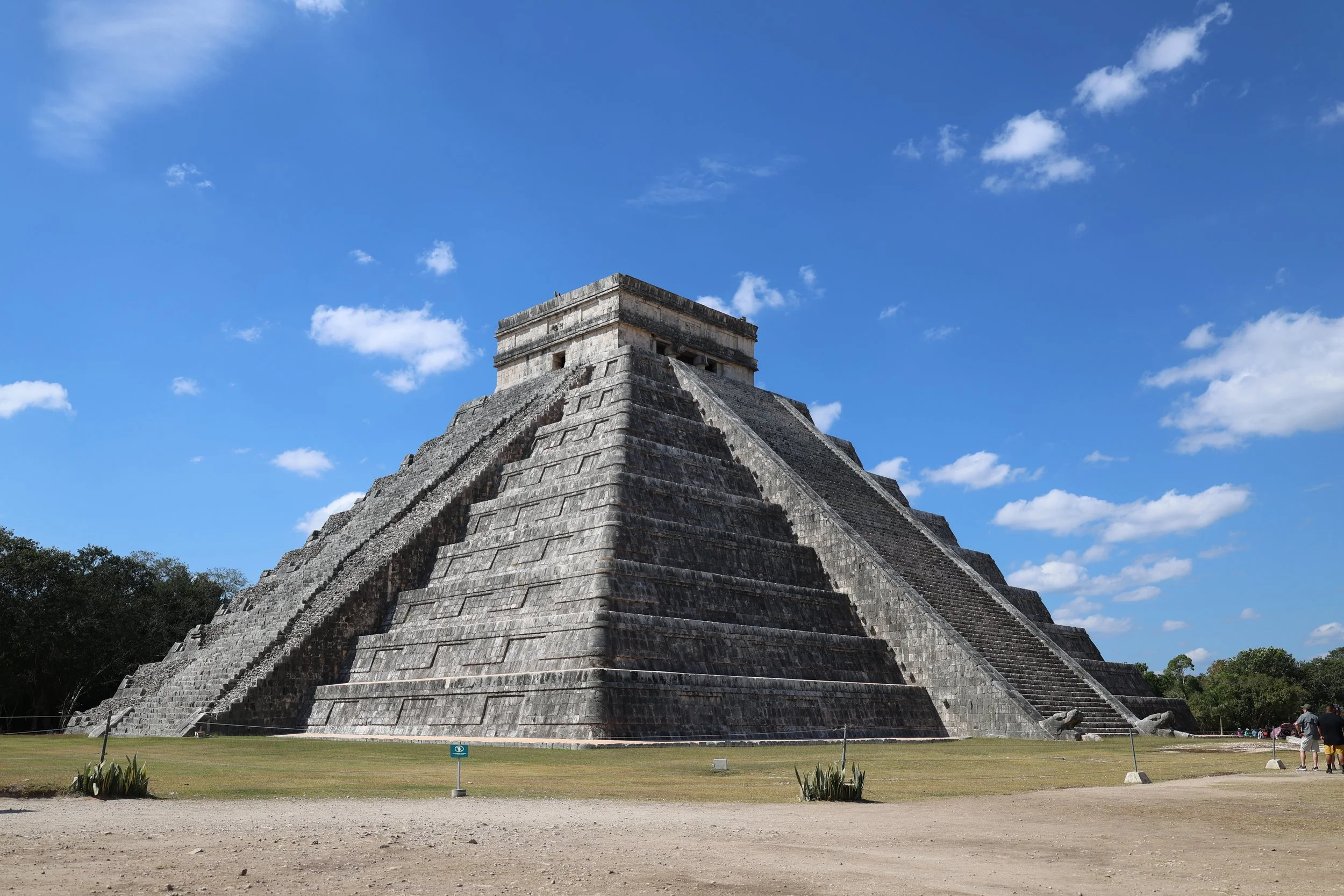
El Castillo, also called the Temple of Kukulkán, is bigger and more imposing than anything at Tulum. It's a stepped pyramid with a staircase on each of its four sides. Each staircase has 91 steps. Four times 91 is 364. Add the platform at the top and you get 365. The whole building is a calendar. We've all owned calendars that were less reliable.
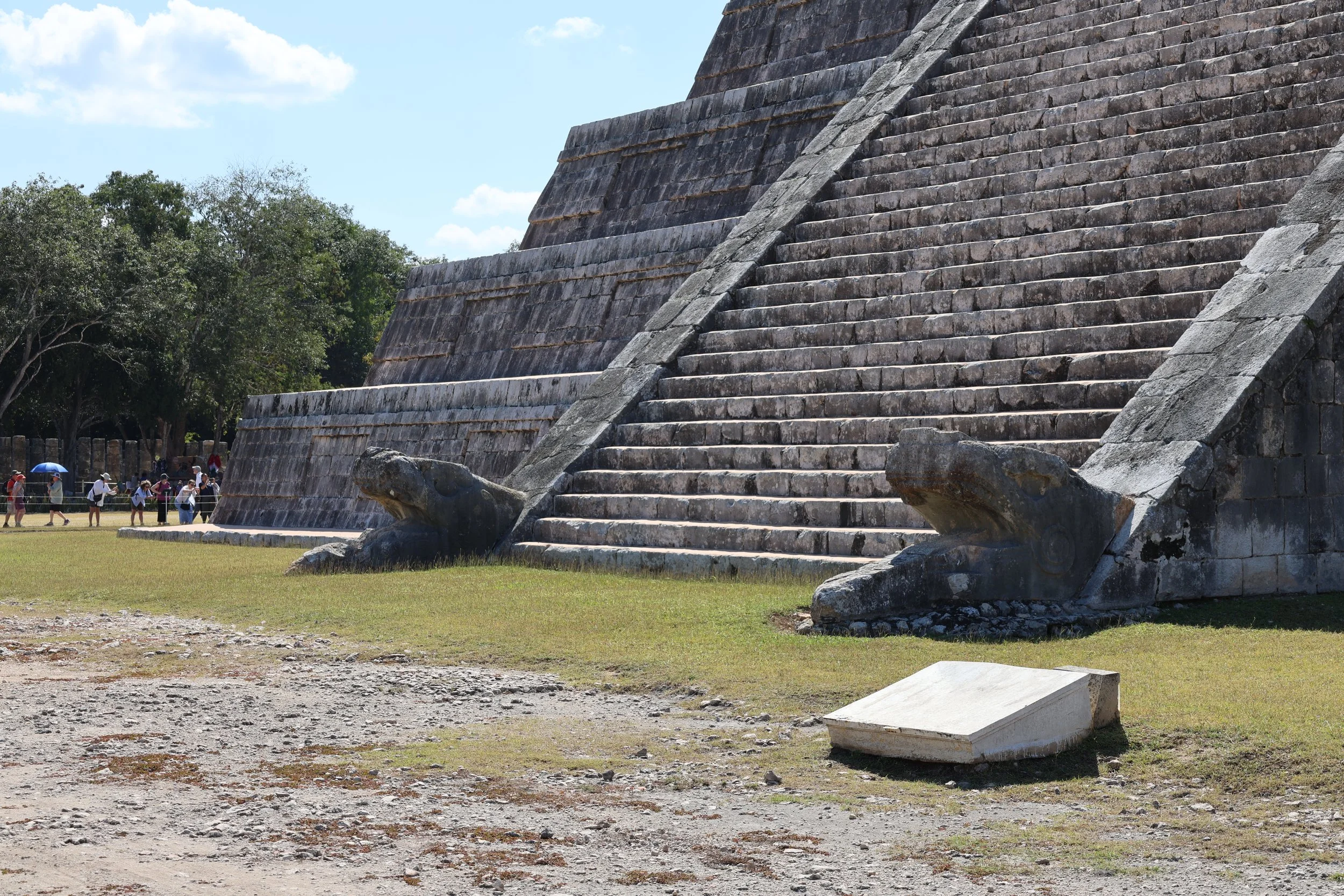
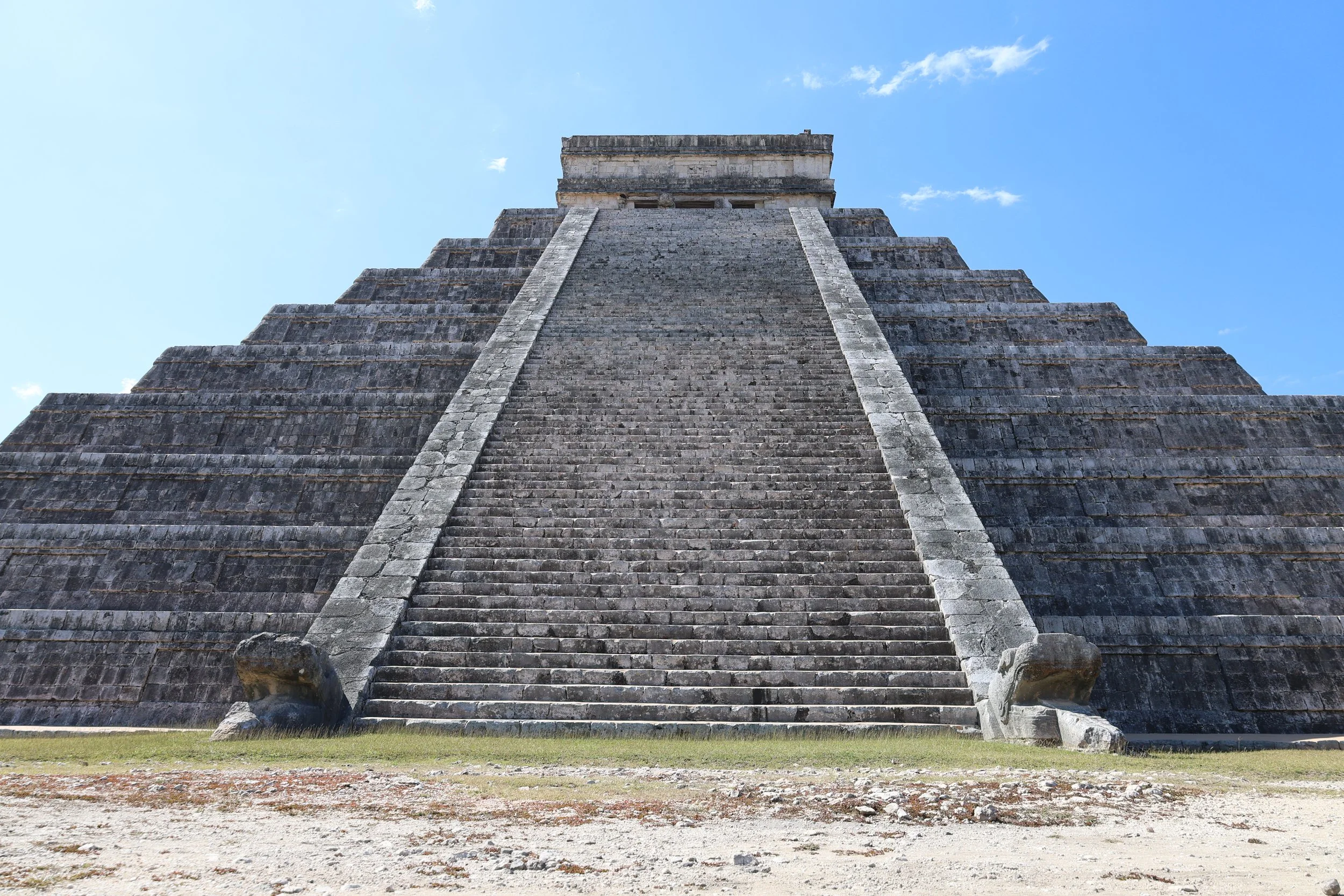
Serpent heads honoring Kukulkán at the base of the stairs, and one of the four 91-step stairways to the top.
A Quick Lesson in Maya Numbers and the Calendar
Victor walked us through how the Maya counted and how they set up their calendar. Honestly, this more than anything set this tour apart from others we've taken. It's worth a minute here, because once you understand it, the pyramid makes a lot more sense.
Start with the numbers. The Maya counted in twenties instead of tens, likely fingers and toes. A dot was one, a bar was five, and a shell stood for zero. Yes, zero. The Maya were among the first people anywhere to use it. With dots, bars, and a shell, they could write any number they needed, and that math is what made their calendar work.
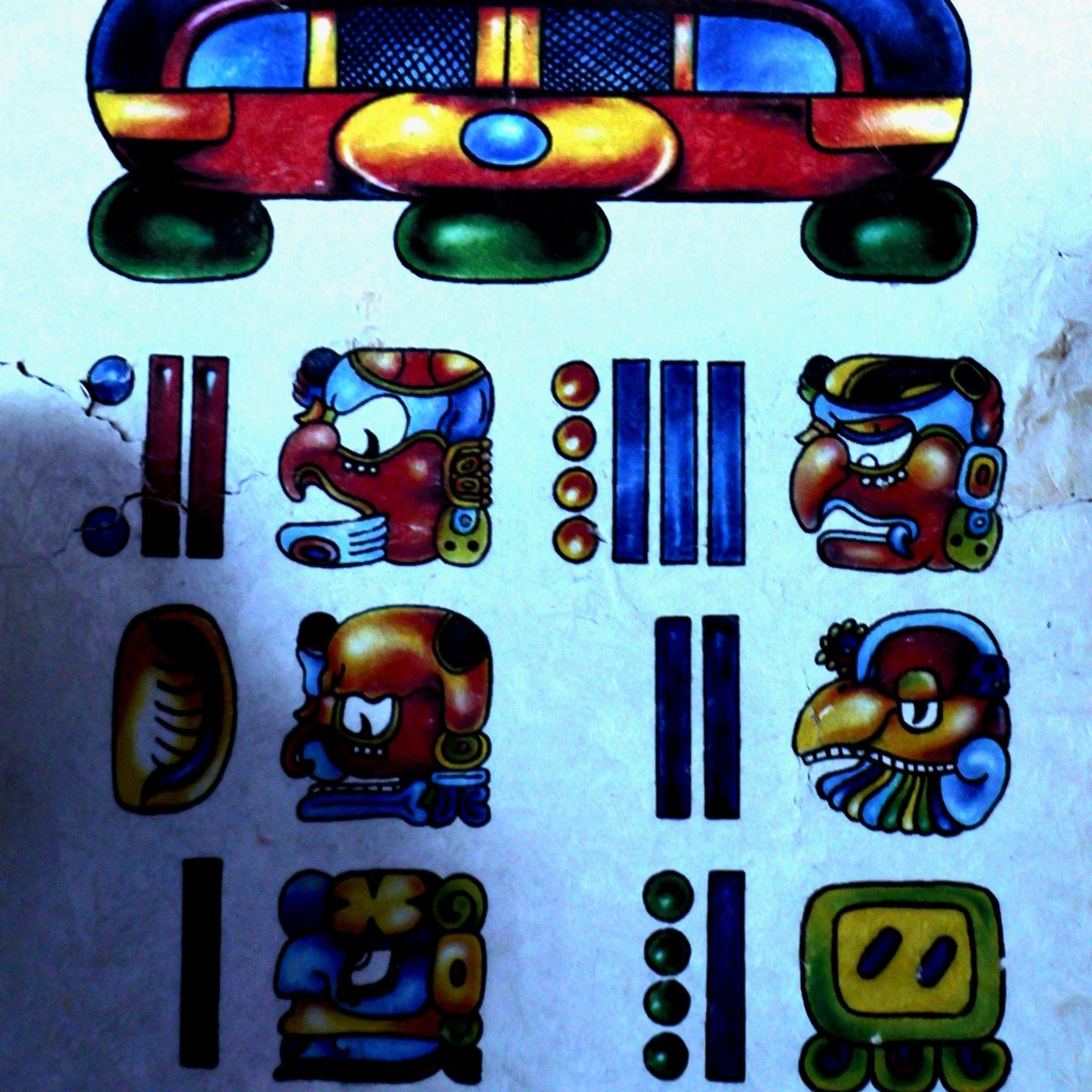
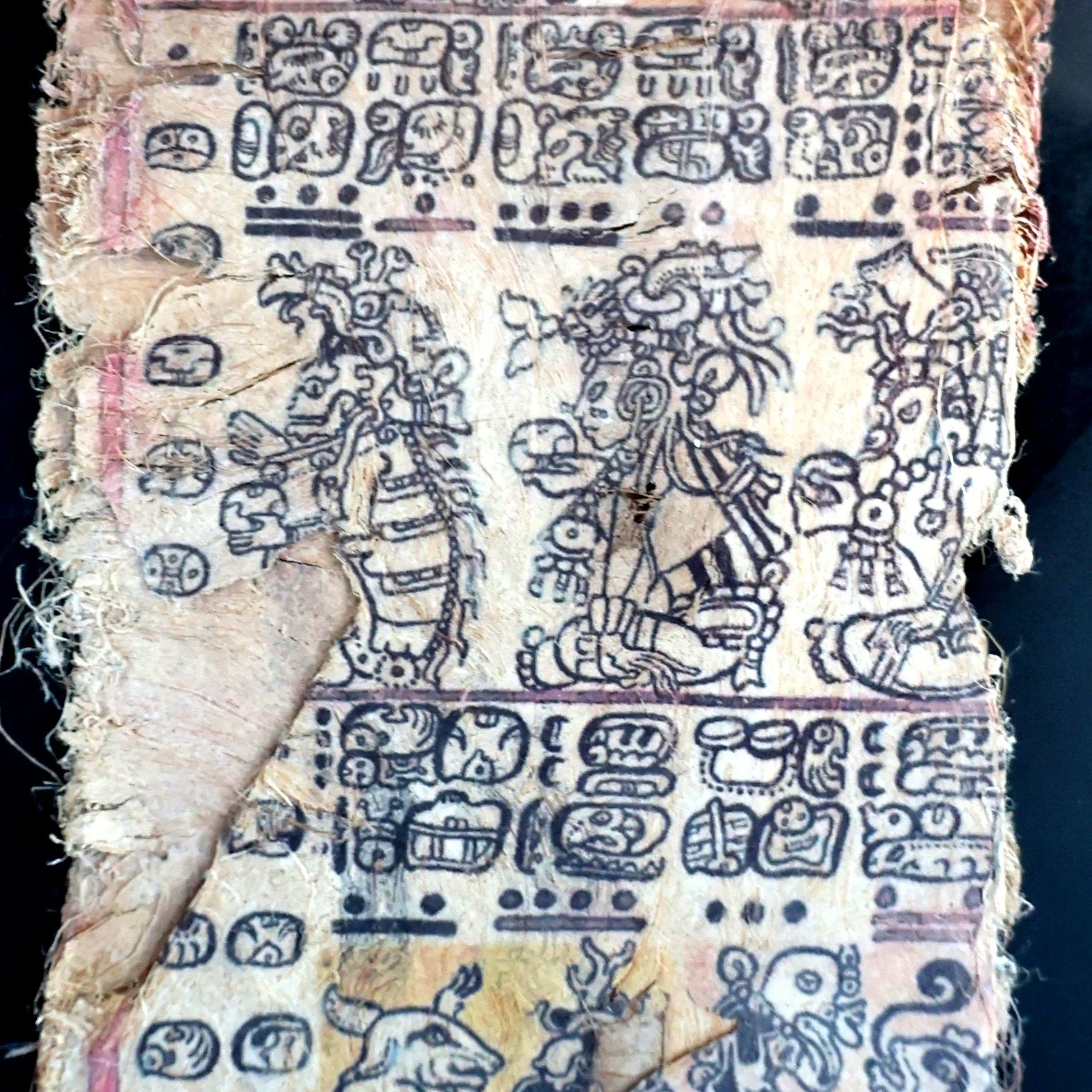
Maya glyphs and a codex-style page. The bars and dots next to the glyphs are numbers: a dot is one, a bar is five.
Then the calendar. The Maya didn't run one. They ran several at the same time, like gears in a watch.
The first is the Haab', the solar year. It has 18 months of 20 days each, which gets you to 360. Then they added five extra days at the end, called the Wayeb', to reach 365. Those five days were considered dangerous and unlucky. We've all had a few weeks like that.
The second is the Tzolk'in, the sacred calendar. It runs 260 days, made by pairing 13 numbers with 20 day names. Nobody knows for sure why 260. Theories range from the length of a human pregnancy to the corn-growing season. It was used for ceremonies and for deciding which days were good or bad for something.
Run those two side by side and they only land on the same combination once every 52 years. That cycle is called the Calendar Round, and reaching the end of one was a big deal, a bit like us turning a new century.
There was also the Long Count, used to date history across thousands of years. That's the one that finished a major cycle on December 21, 2012, the date plenty of people decided meant the end of the world. It didn't. It was more like an odometer rolling over.
How the Pyramid Matches the Calendar
Now look at El Castillo again. The 365 steps are the Haab' year. Each side has nine terraces, and the staircase splits them in two, which gives you 18 sections per side, one for each month of the Haab'. And each face has 52 flat panels, one for each year of the Calendar Round. The year, the months, and the 52-year cycle, all built into one building. Then the builders lined it up with the sun, which is where the serpent comes in.
The serpent heads at the bottom of the stairs are part of the pyramid's best-known trick. On afternoons around the spring and fall equinoxes, the sun throws a line of triangle-shaped shadows down the edge of the staircase, and they connect to the stone head at the bottom. The result looks like a snake sliding down the pyramid. We weren't there on an equinox, but after Victor explained it, we looked at those heads differently.
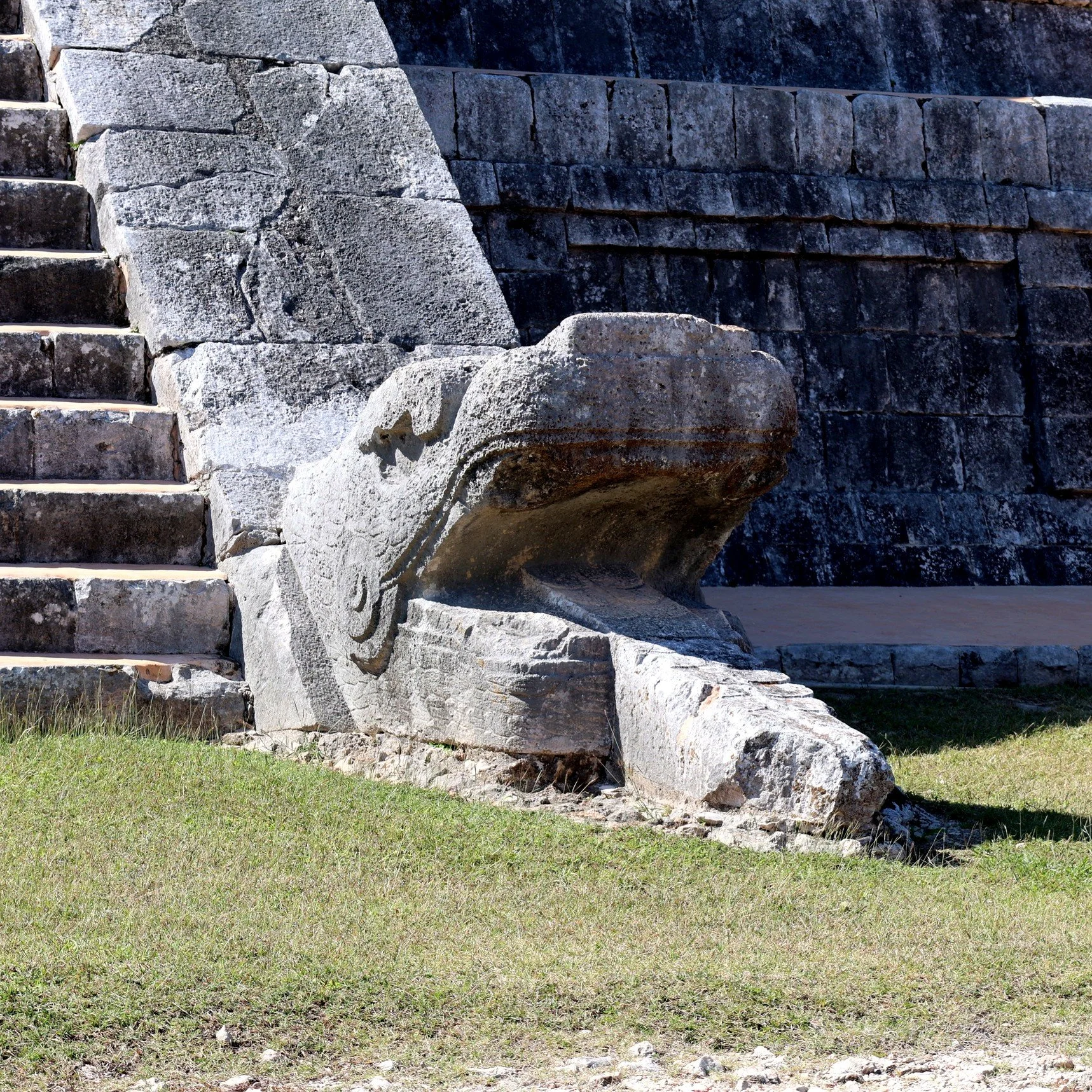
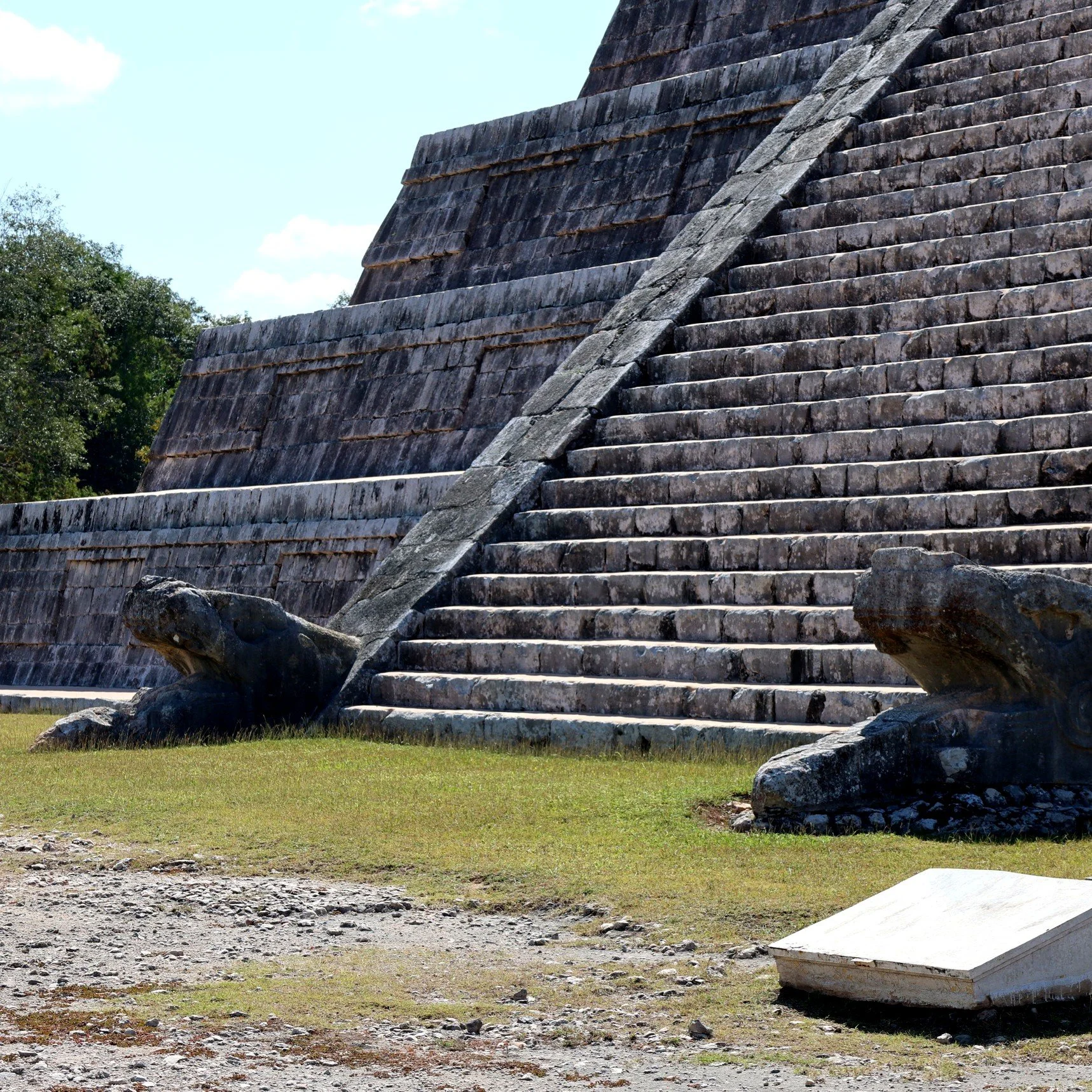
Kukulkán's serpent heads at the base of El Castillo, where the equinox shadow "snake" meets the ground.
There's more going on underneath, too. Victor told us the Maya built new pyramids right on top of old ones, and El Castillo is layered like that. Archaeologists found an earlier temple inside it in the 1930s. He also said the site sits over cenotes, the natural sinkholes that were the Yucatán's only fresh water, with one directly under the main temple. Researchers confirmed a cenote beneath El Castillo with ground imaging in 2015. Even the name is about water. Chichen Itza is usually translated as "at the mouth of the well of the Itza."
You can't climb it anymore. It's been closed to climbing since 2006. At our age, we didn't argue. Besides, the best thing it does, you can experience from the ground.
The Pyramid That Chirps
Victor lined us up in front of the main staircase and clapped once.
The sound came back about seven times, and it didn't sound like a clap. It bounced off the steps, the pitch changed, and it came back as a chirp, close to a birdcall. Victor tied it to the quetzal, a bird sacred to the Maya. Its long green feathers are the "feathered" part of the feathered serpent. So the pyramid built for Kukulkán answers you in the voice of the bird that gave him his feathers.
Whether the Maya did that on purpose is still debated. Standing there, it sure felt intentional. And we'll admit it: we'd have walked right past it if Victor hadn't stopped us. If you ever need to explain why a good guide is worth the money, that one clap makes the case.
"We clapped at a 1,000-year-old pyramid, and it chirped back. We'd have walked right past it without a guide."
Temple of the Warriors and the Cremation Area
Next was the Temple of the Warriors, a stepped temple with rows of carved stone columns out front that once held up a roof. Standing in front of all those columns is when the size of this place finally sank in. This wasn't a religious site with a handful of buildings. It was a capital city.
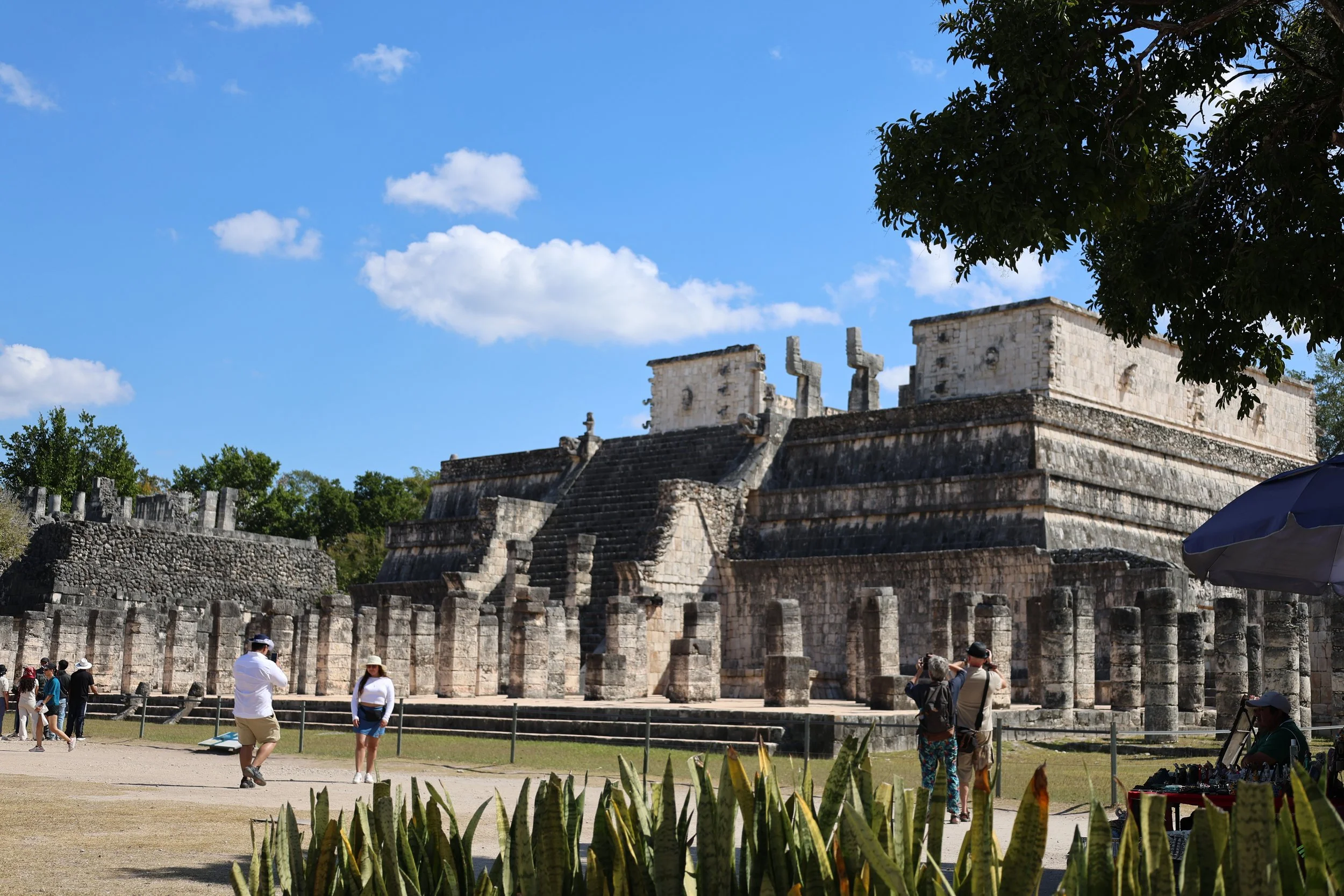
The Temple of the Warriors and its rows of columns.
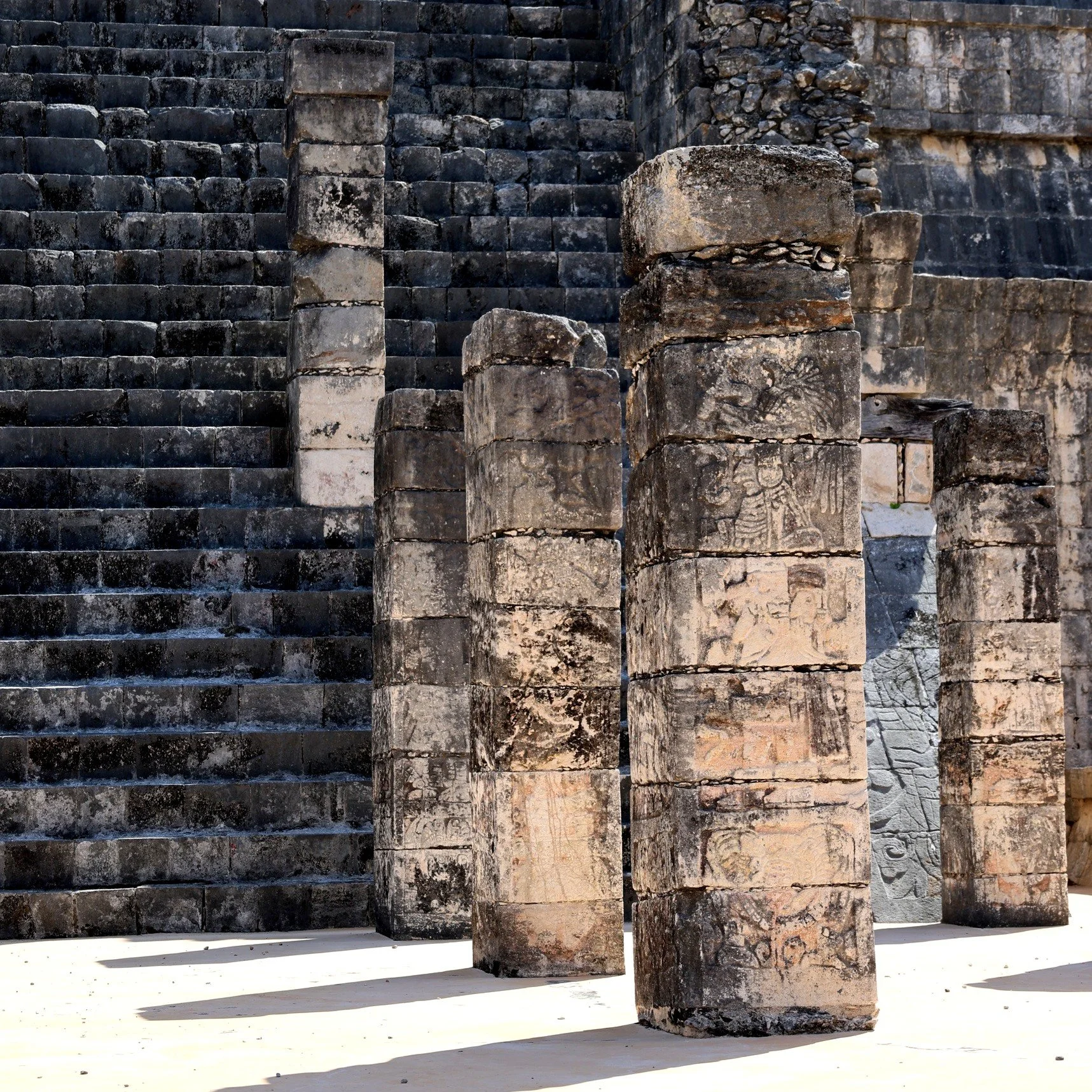
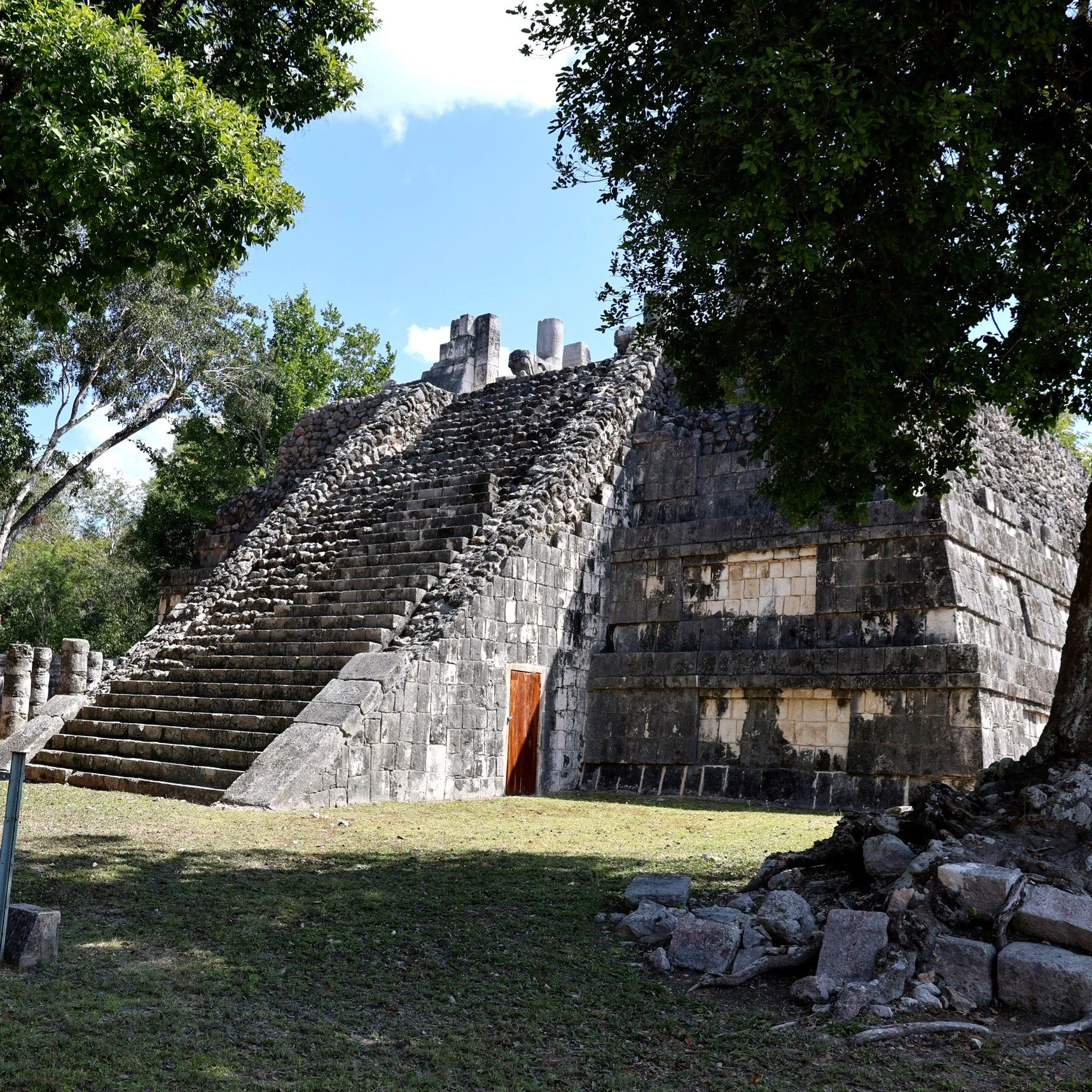
Up close with the carved columns, and one of the smaller temples nearby.
Victor walked us through the animals carved into everything. The serpent, the jaguar, and the eagle each stood for gods and ideas in Maya belief. Once you know to look for them, you see them on every wall. The jaguar on one of the smaller temples was our favorite detail of the day.
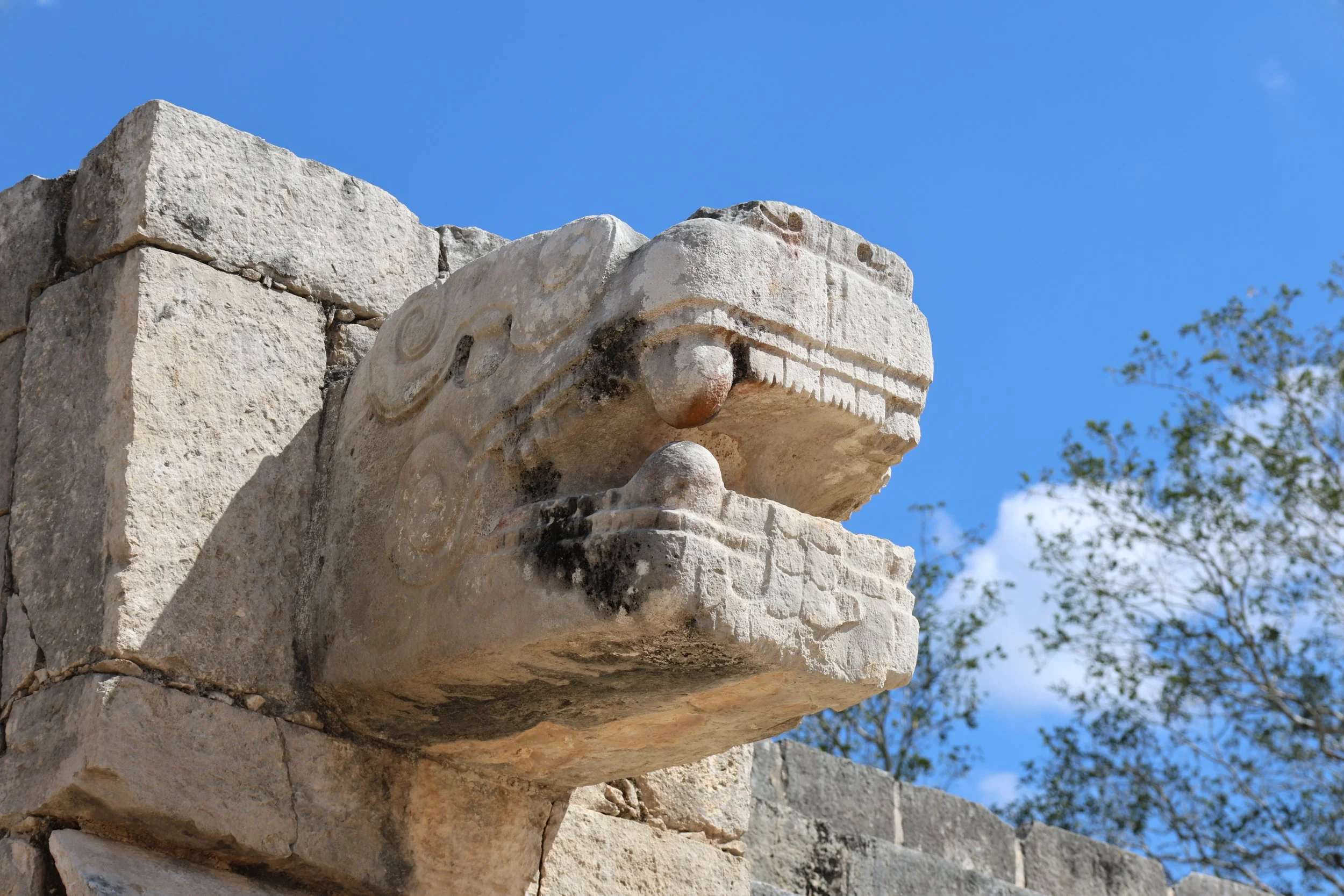
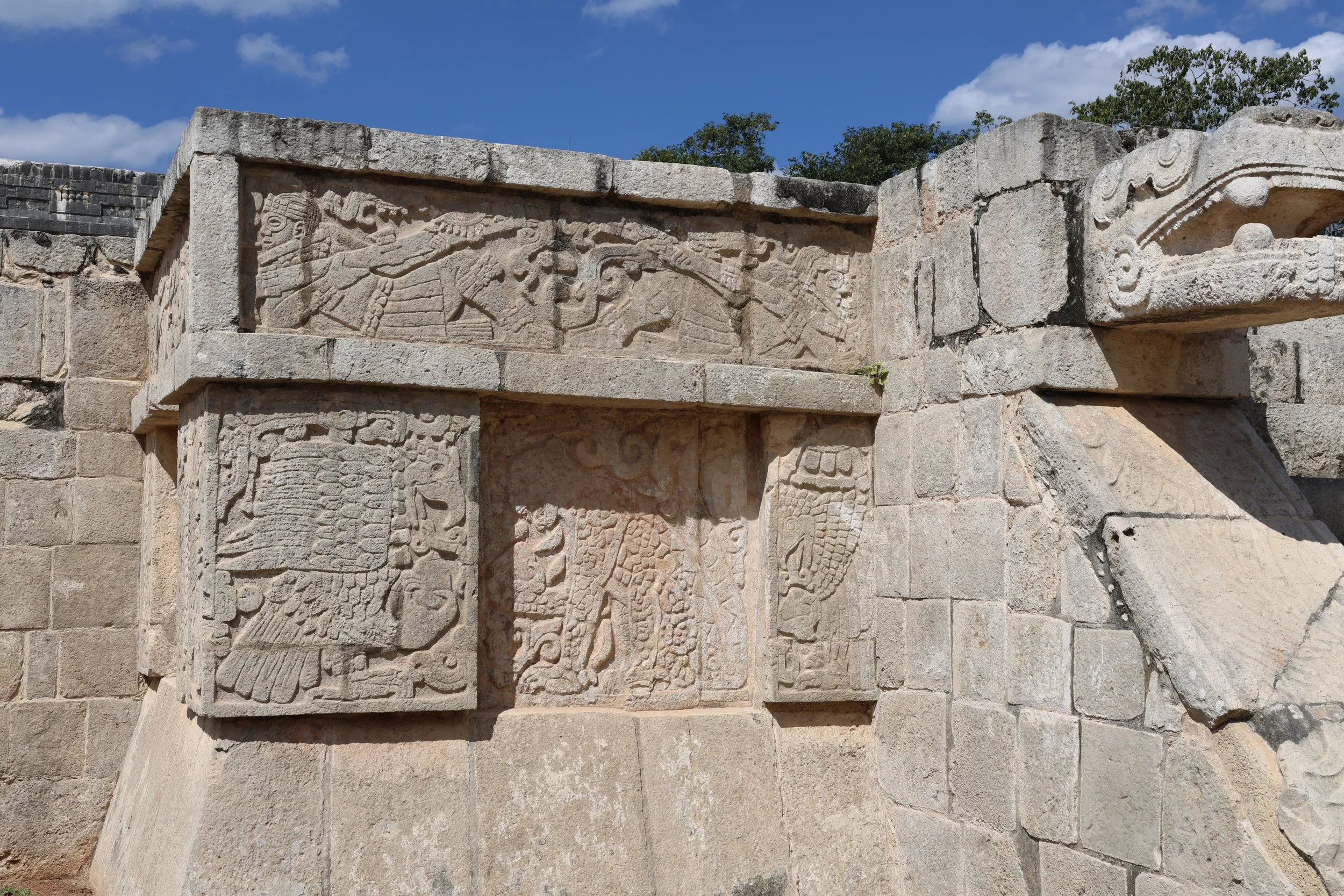
A jaguar carved into a smaller temple, and more of the stonework nearby.
From there, Victor took us to the cremation area. It doesn't look like much next to El Castillo, and most groups walk right through. We're glad we didn't. Victor told us the Maya here didn't bury their dead, people or animals. They cremated them and used the ashes to return them to the earth and fertilize the land. That's his account of Chichen Itza. Across the wider Maya world, burial was common too, including royal tombs like the famous one at Palenque, so practices varied from place to place. Either way, the big monuments show you what the Maya wanted the world to see. This shows you how they thought about life, death, and the land that fed them. Victor described the carved faces on one platform as ancestors who had already passed on to the land of the gods.
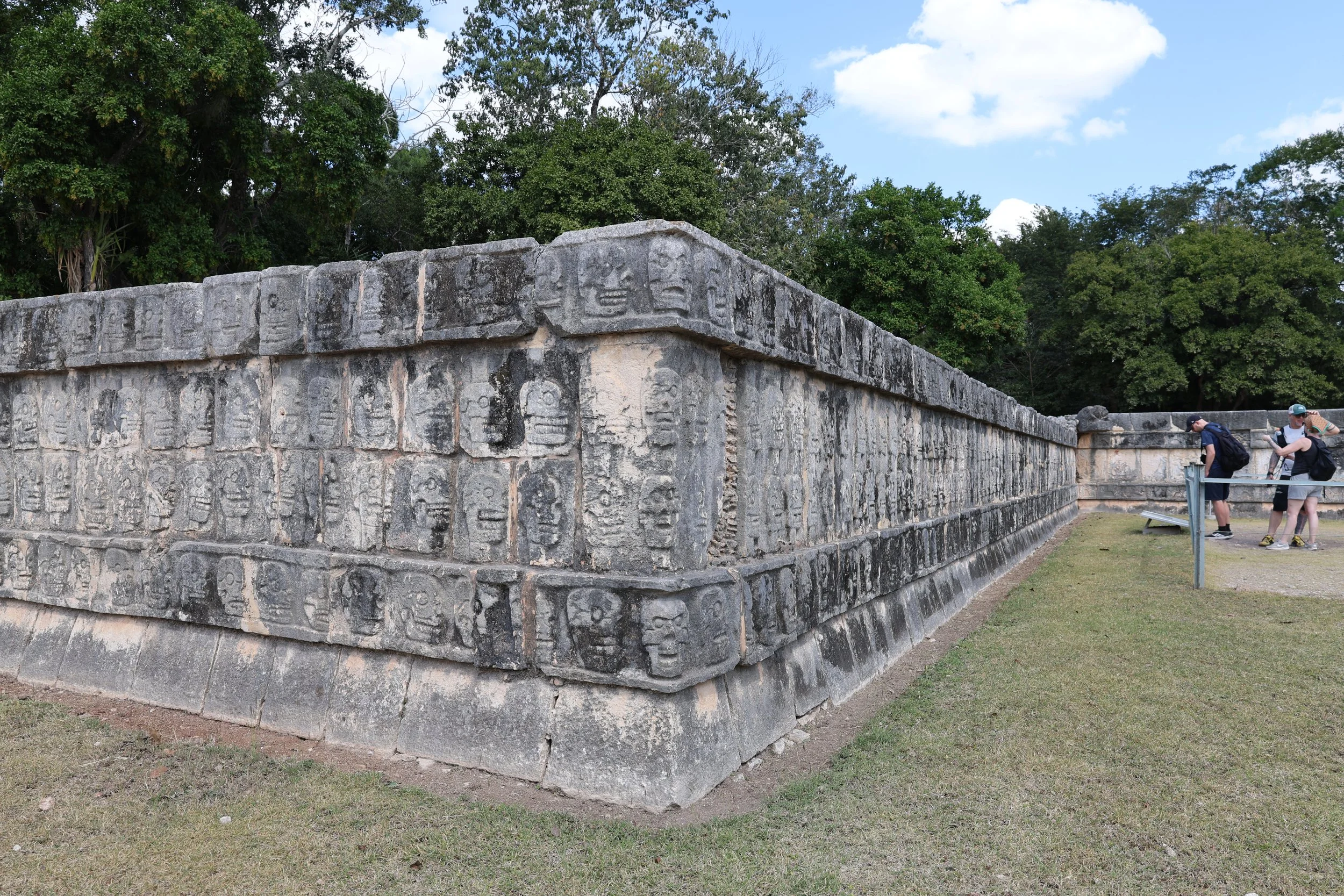
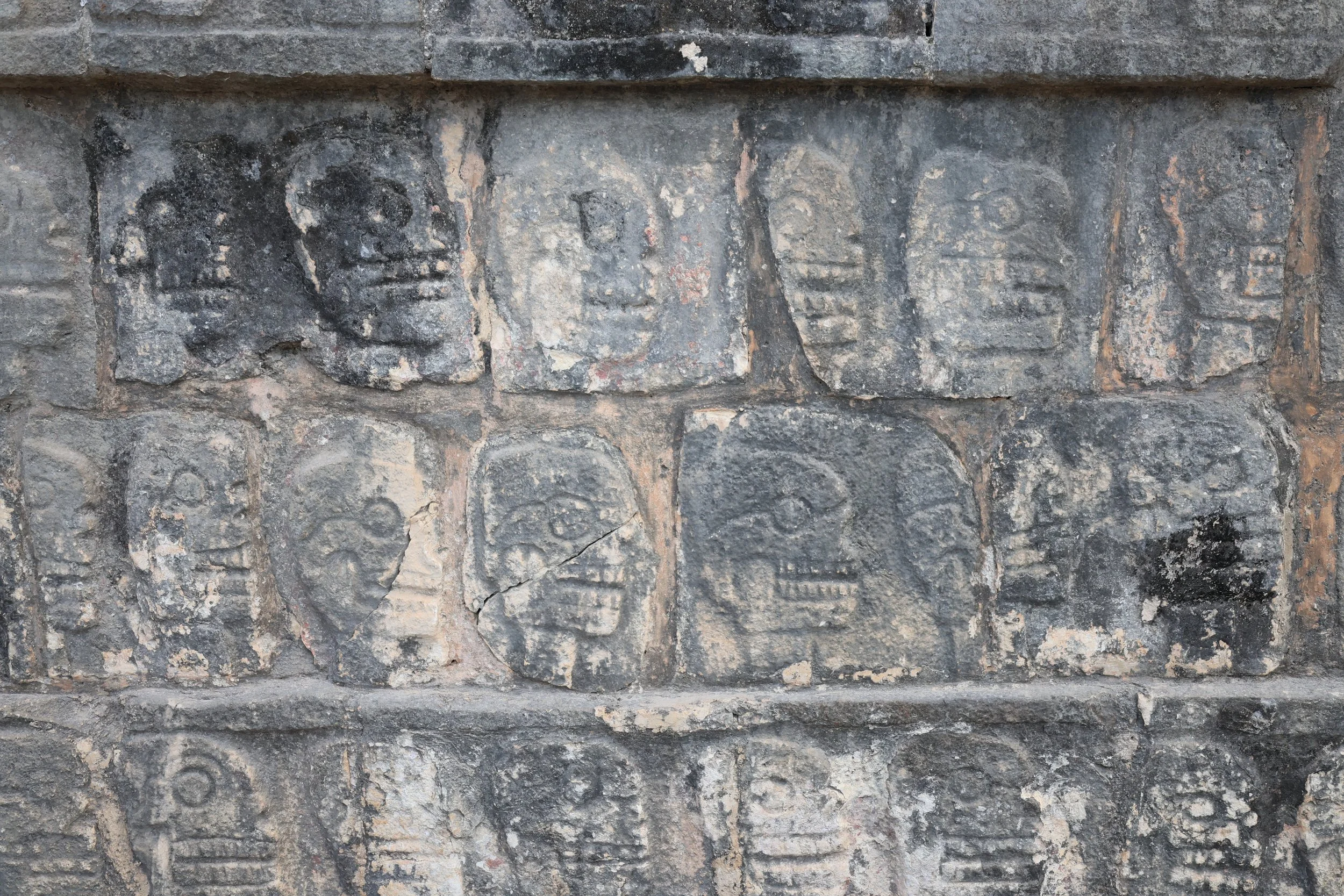
The cremation platform, and carvings our guide described as the faces of ancestors who had passed on to the land of the gods.
The Great Ball Court
After that came the Great Ball Court, the largest in the Maya world. Picture a grass field longer than a football field, with high stone walls on both sides and a stone hoop set way up on each wall. Players had to get a heavy rubber ball through that hoop without using their hands. We've watched our share of soccer games. This would have been harder.
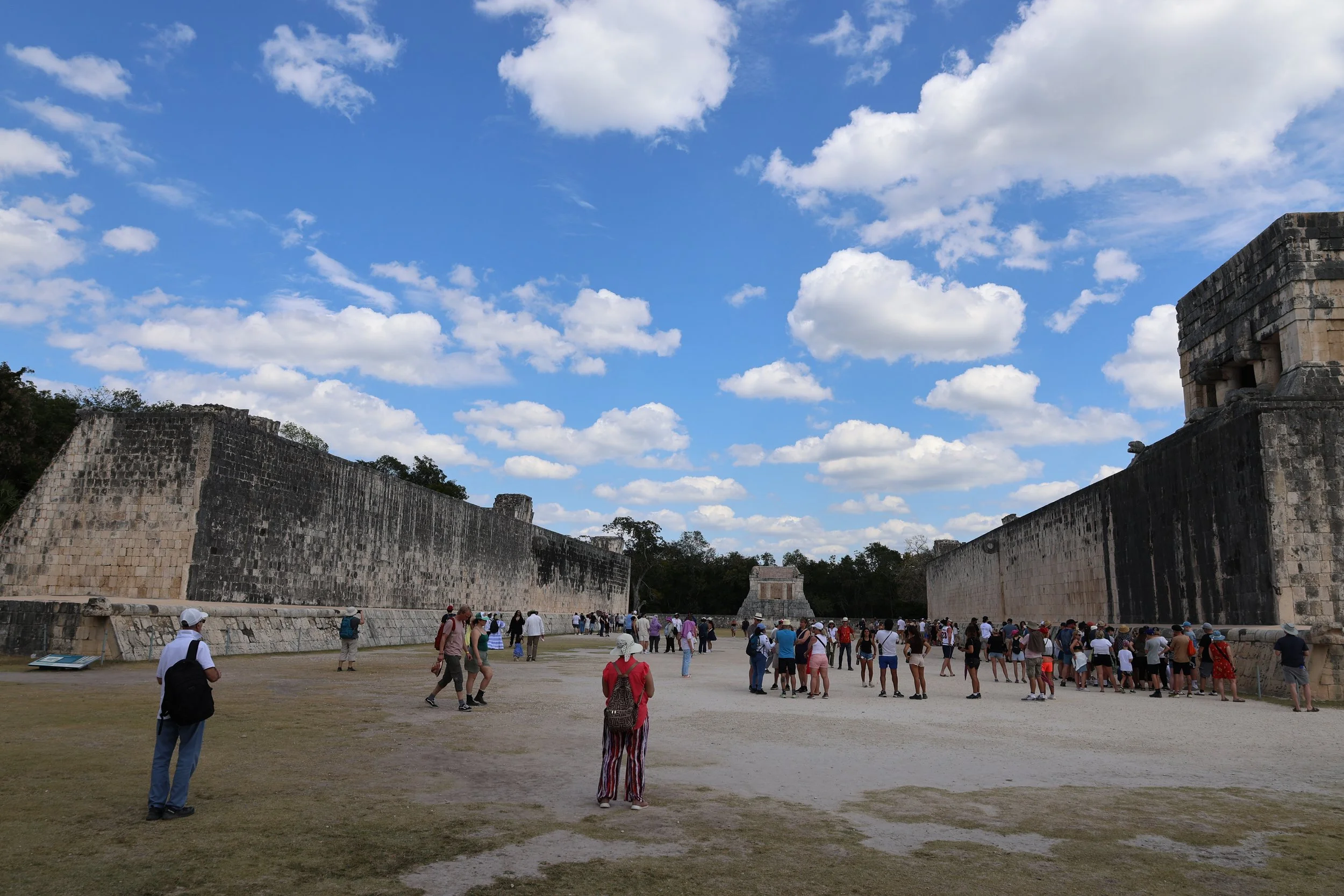
The Great Ball Court, looking toward the area where the royal family watched the game.
This is where the story gets uncomfortable, and where Victor changed our minds about something. The version most of us grew up with is that the losing team was sacrificed. Victor told it differently. He said each team had seven players, six on the field and a captain up above, and it was the winning captain who was sacrificed, with the losing captain performing the ritual. He also said many people volunteered. It wasn't punishment. It was an honor that could raise a family's standing.
Historians still argue about how often the game ended in sacrifice and who was chosen, so treat any single version as one interpretation. Either way, it changed how we saw the place. It wasn't a stadium where the losers got executed. It was closer to a temple with a game in it.
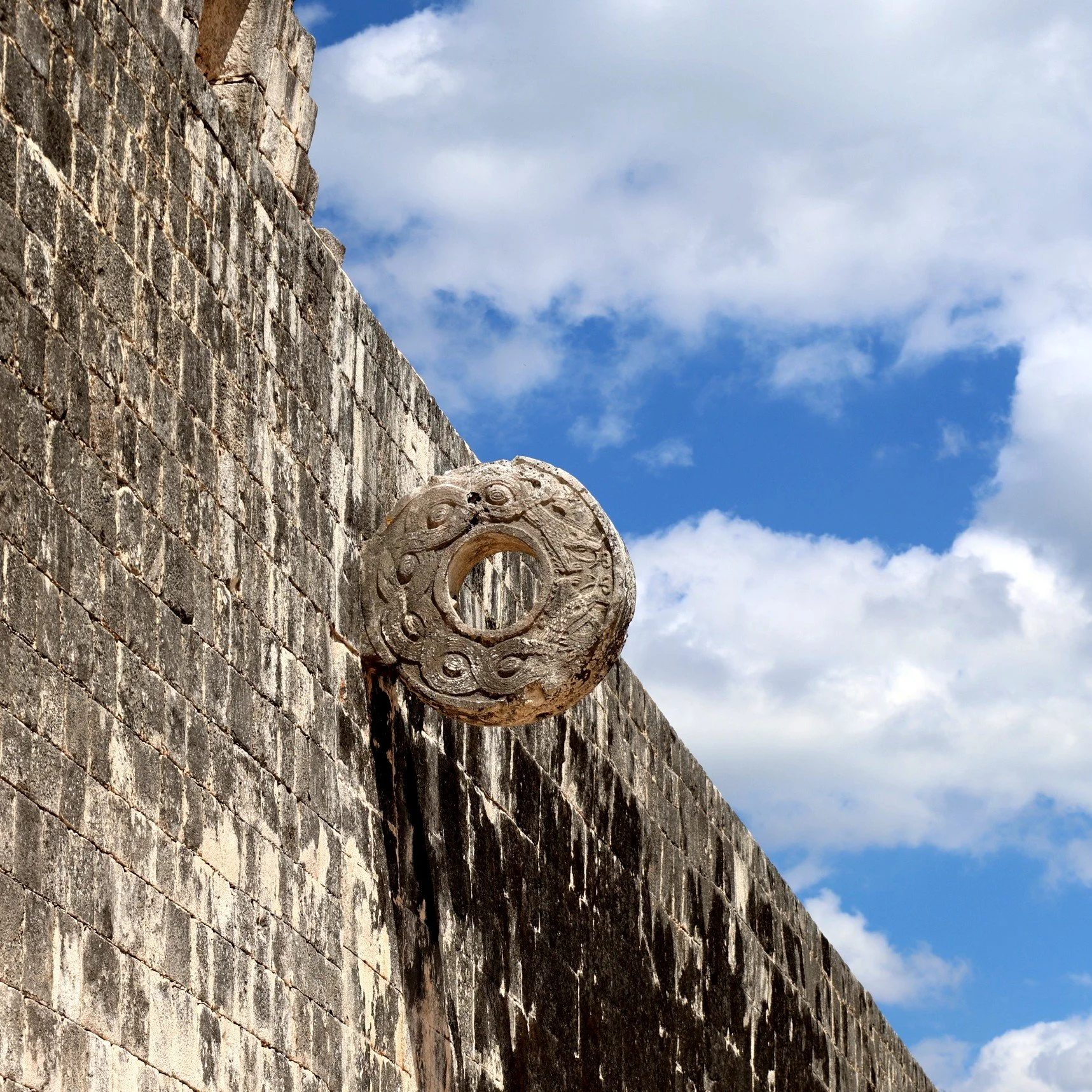
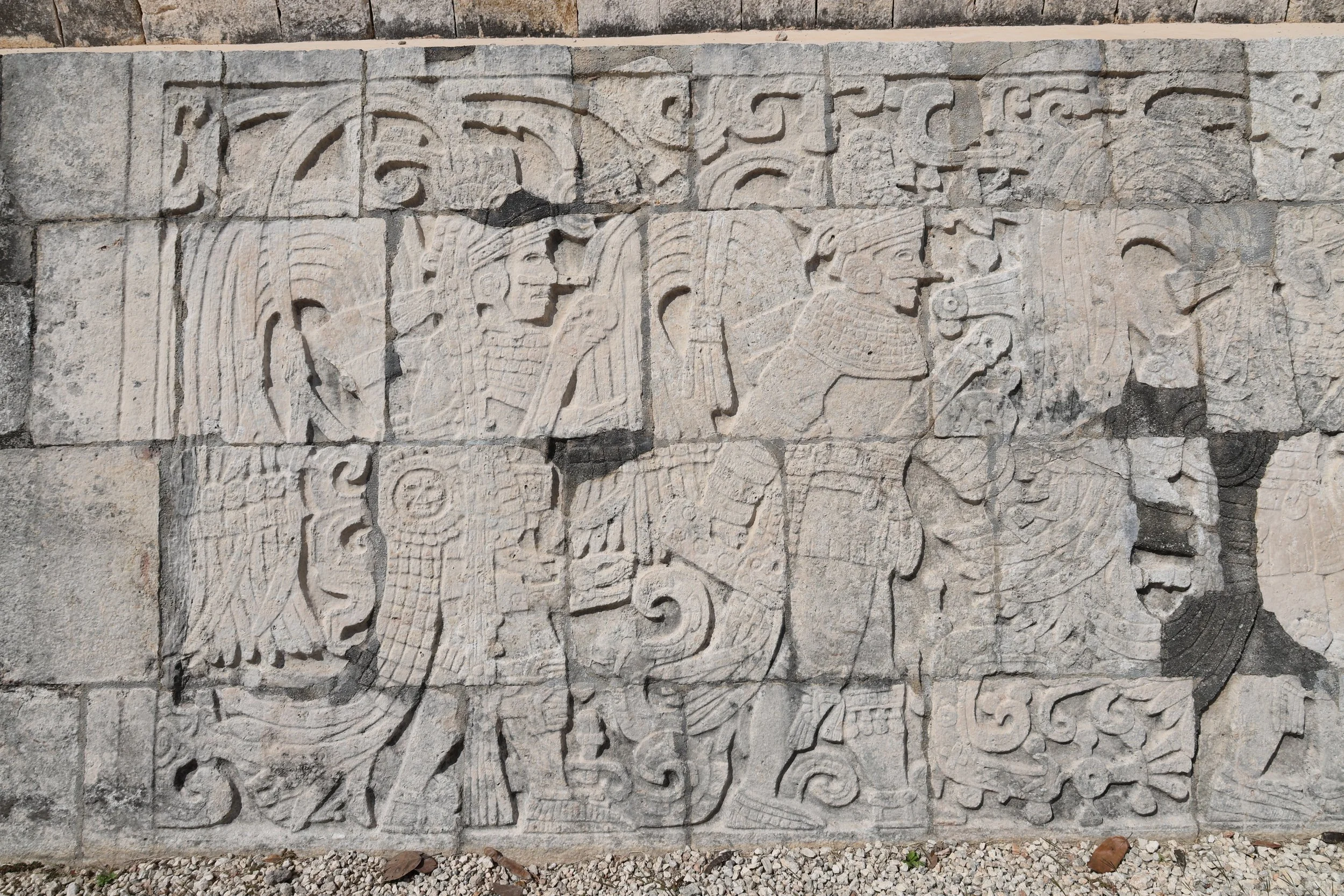
One of the two stone hoops, and carvings along the wall showing two of the seven players on a team.
Then the sound again. Victor had us spread out, and a small noise at one end of the court carried clearly to the other. In a space that size, it shouldn't work. It does. Between the echo at El Castillo and this, we started to think the Maya cared about how their city sounded as much as how it looked. We've sat in modern arenas with worse acoustics.
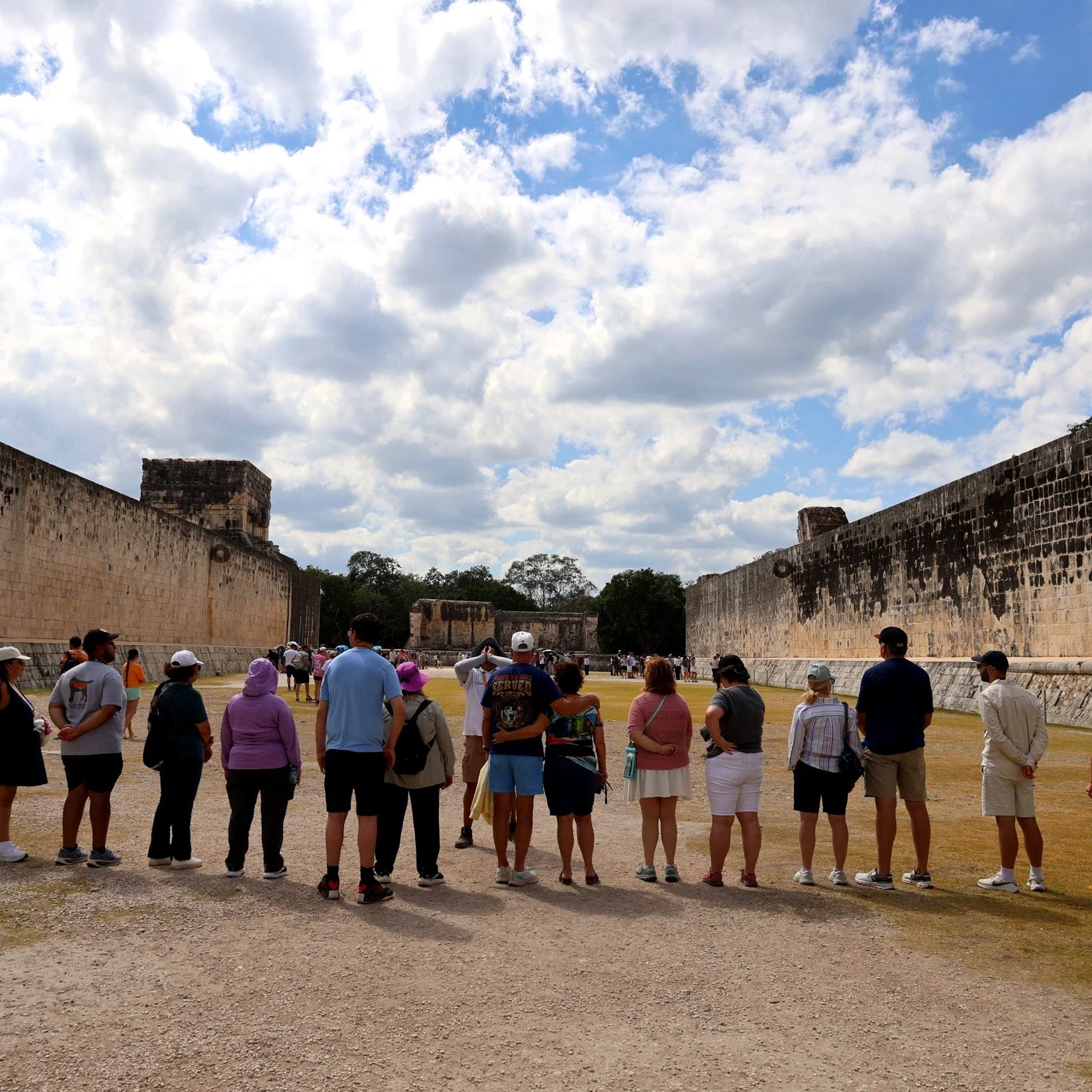
Lined up on the Great Ball Court. A small sound at one end carries all the way to the other.
Finishing with Mask Making
The last stop wasn't a ruin at all. It was a mask-making demonstration. One man sat carving a mask by hand while another showed us how dried flowers and bark were used to make the paints for it. After a day of looking at what the Maya built a thousand years ago, it was a good way to finish: two men still doing the work by hand, right in front of us.
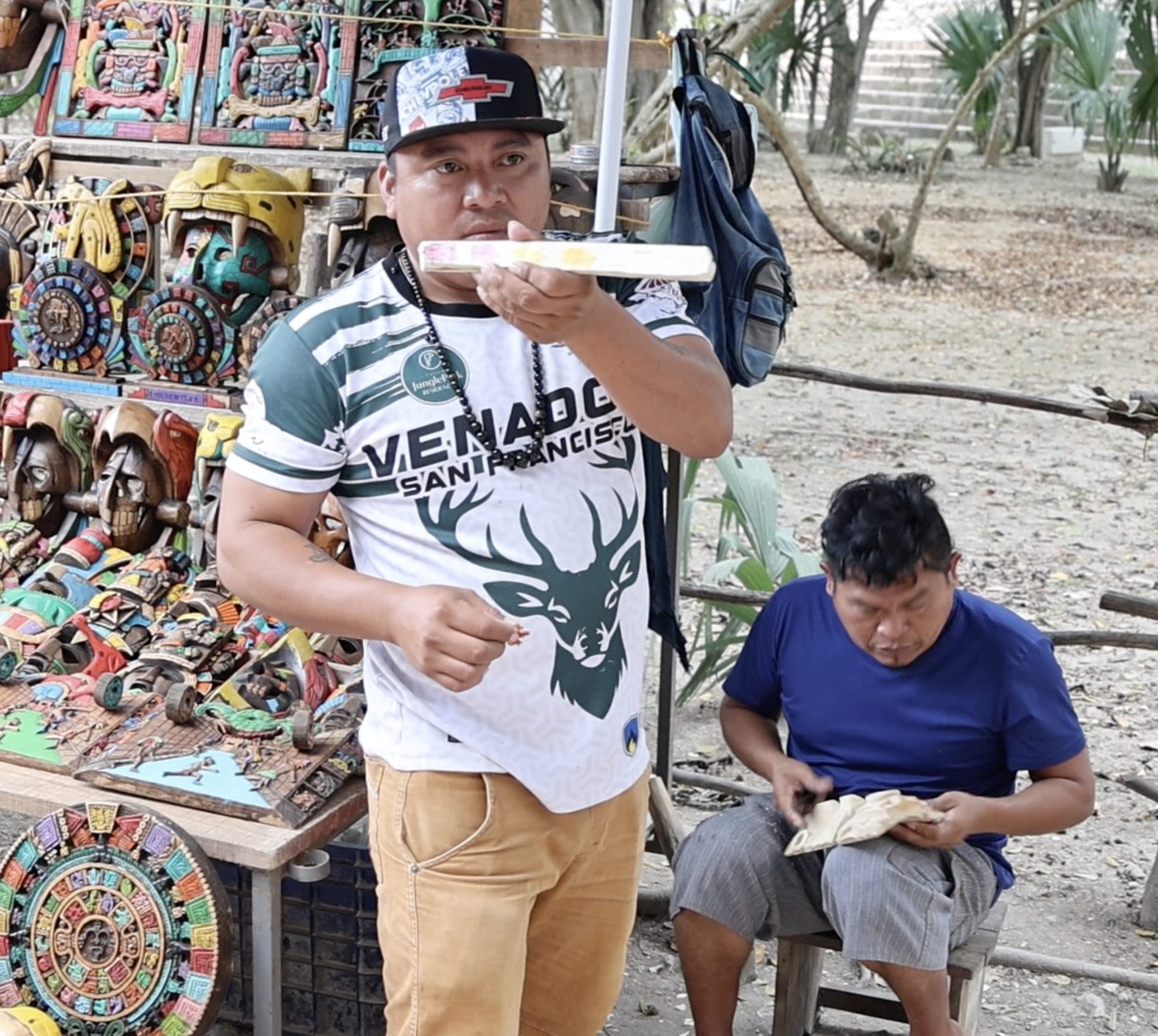
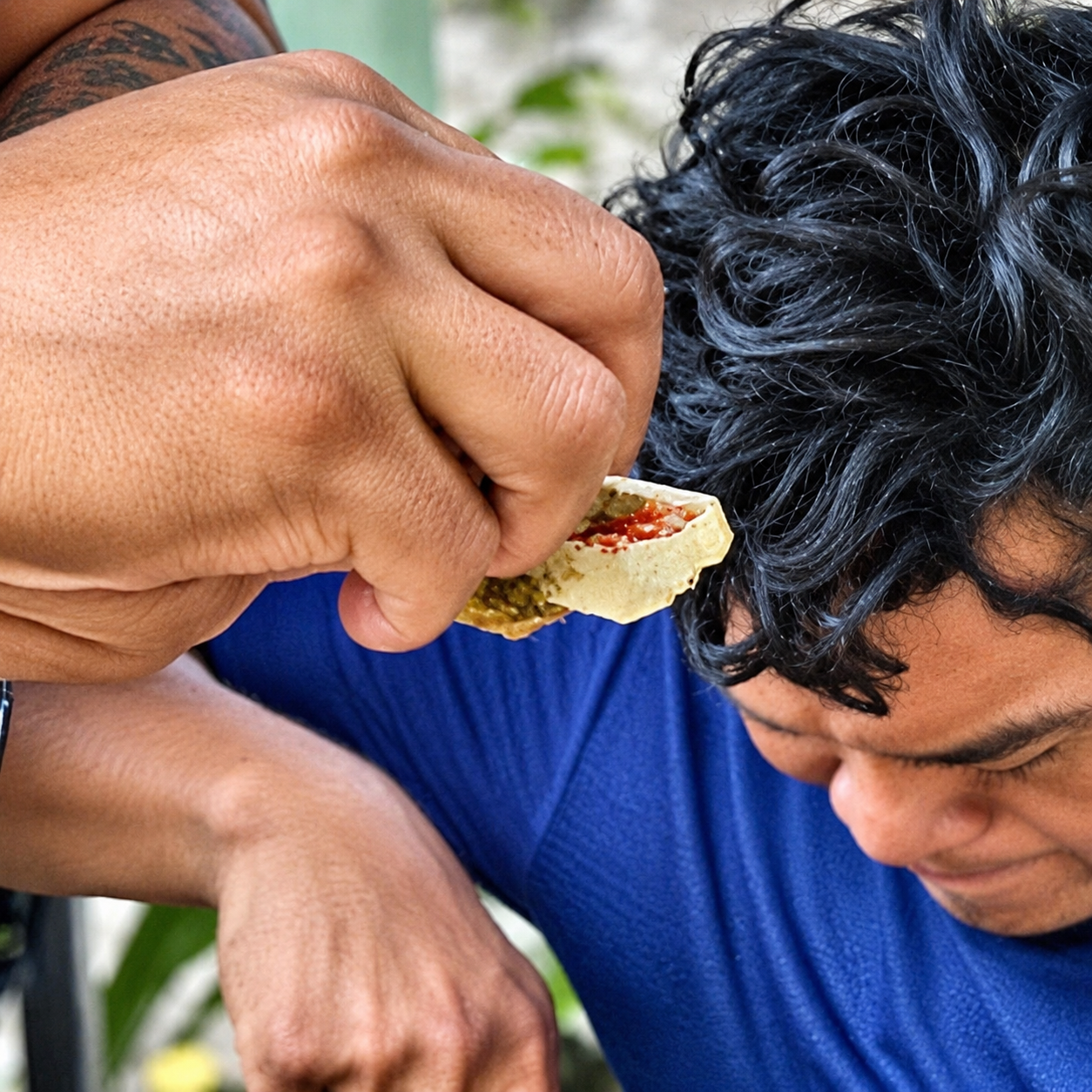
Turning dried flowers into paint: the color goes straight from the flower onto the wood.
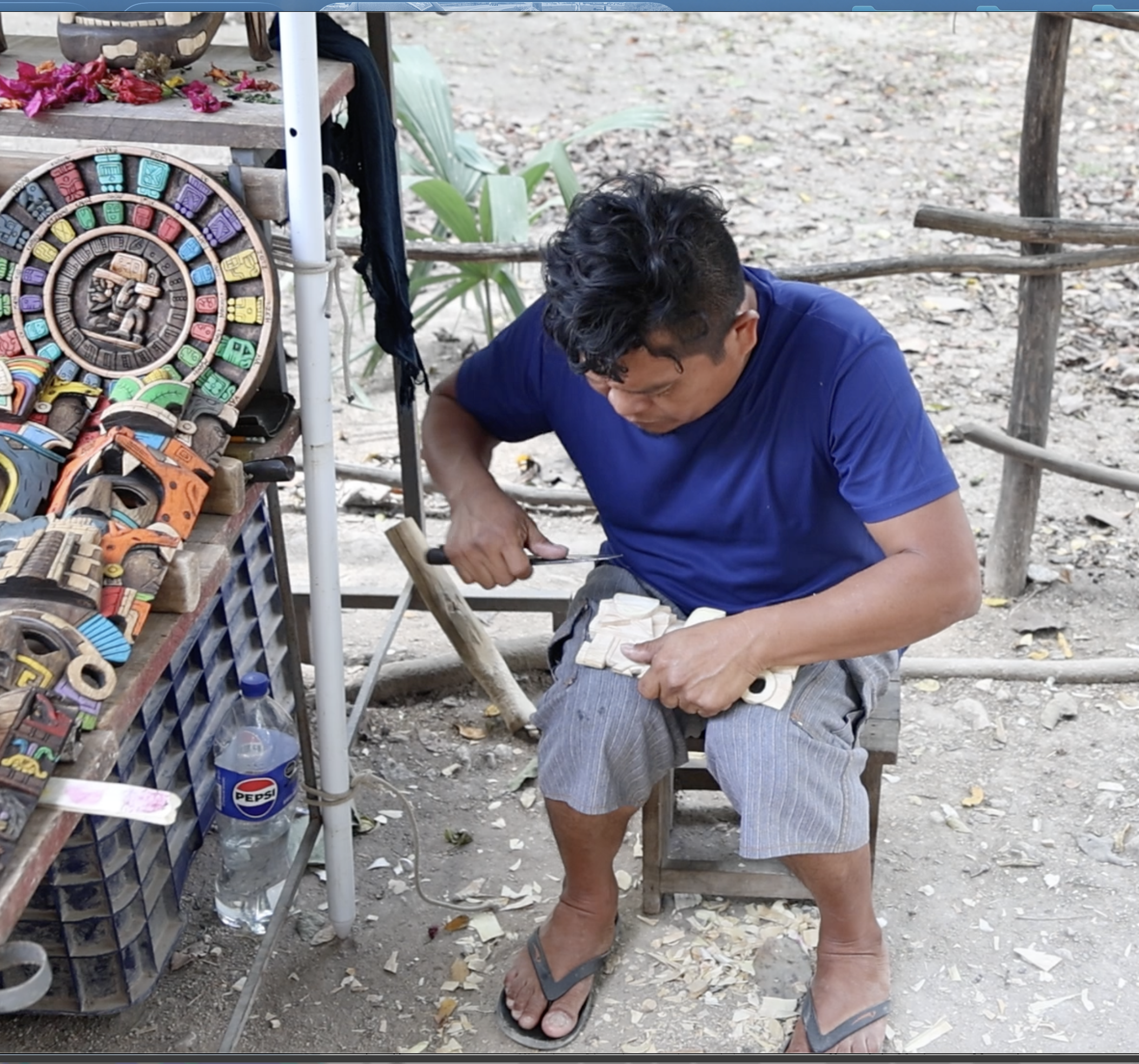
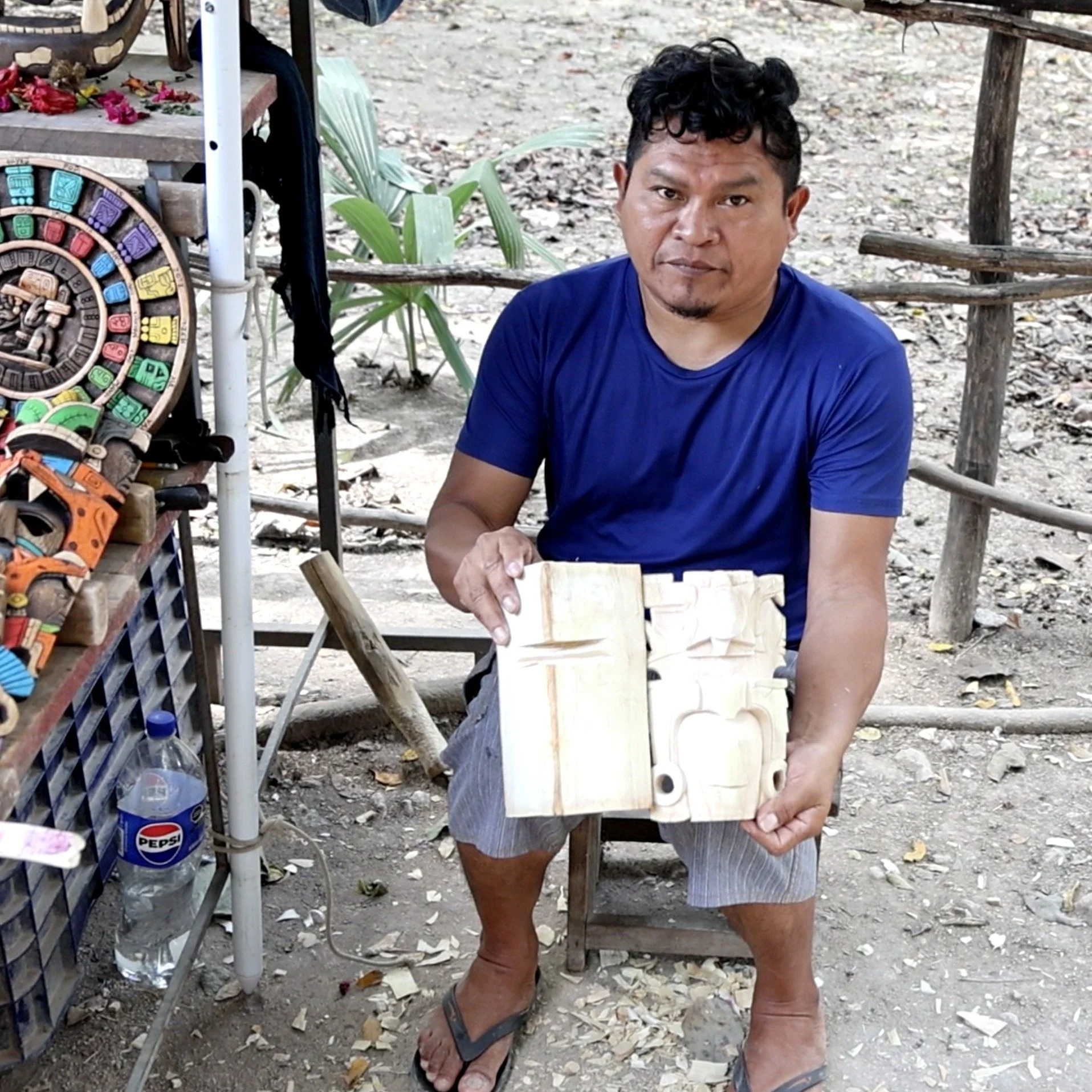
From a plain block of wood to a carved mask, all by hand.
Before You Go
Practical Tips for Chichen Itza from Cozumel
- Plan on the whole day. We left the ship at 7:00 a.m. and were back around 4:30 p.m. Don't try to squeeze in a beach.
- Use the bathroom at the bus terminal. Seriously. Once you're in the van, there's no bathroom stop for the whole drive. There's a bathroom at the bus terminal before you leave. Use it!
- Pack water, snacks, and real food if you can. Eat a good breakfast on the ship. The tour provided a small snack, but it's not a lunch replacement, and that's not lunch for a grown man. Just remember food isn't allowed inside the archaeological zone itself.
- Expect crowds. Chichen Itza drew about 2.2 million visitors in 2025, roughly 6,000 a day on average, more in high season and around the equinoxes. Early February already felt busy to us. Staying near Cancún before or after your cruise? An early-access tour with hotel pickup gets you in before the crowds and the heat. Going on your own? A skip-the-line entrance ticket gets you through the express entrance.
- Leave the tripod on the ship. Tripods, monopods, and selfie sticks weren't allowed during our visit. Phones and standard cameras were fine. GoPros carried an extra fee.
- Backpacks and water are fine inside the site, food isn't. Bring a refillable bottle and keep it full.
- Know the pace. The tour is structured, with no free time to wander on your own. We'd have gladly taken another 30 minutes. Instead we had spare time at the ferry, which is not where you want spare time.
- Book it through the ship. From Cozumel, the cruise line's shore excursion is the only way to get there. Independent Chichen Itza tours leave from Cancún and Playa del Carmen, not the island. Excursions like this fill up, so book early.
Final Verdict: Is Celebrity's Chichen Itza VR Tour Worth It?
Yes, if you're willing to give it the whole day. It's a long excursion, and it's built for people who actually want the history, not just the photo.
What set this tour apart, more than anything, was Victor walking us through the Maya number system and how they built their calendar. Once you understand that, the whole site reads differently. The small group helped too, twelve people instead of sixty, and so did the tablets that let you see the city in color while you stood in front of the gray stone. Take those away and it's a long bus ride to look at old stones. With them, the pyramid chirps, the ball court talks back, and the carvings start to make sense.
And the ruins themselves are remarkable. The level of preservation is what stayed with us most. Some of what you see was restored in the 20th century, but standing in front of carvings that still show individual faces and feathers, you don't feel like you're looking at rubble. You feel like the city could fill back up tomorrow.
It's not perfect. The day is long. The site is crowded. The pace is set for you, and there's no free time to wander. And the "VR" is tablets, not headsets, which we actually prefer. You came all this way to look at the real thing, not a screen strapped to your face. This tablet version is offered on Celebrity and Royal Caribbean sailings. Carnival and Princess run their own Chichen Itza tours, but we haven't seen this format from them.
If your ship doesn't offer it, you're out of luck from Cozumel. There's no practical way to do it on your own from the island. Independent Chichen Itza tours leave from Cancún and Playa del Carmen, so here's the other way to do it. Plenty of Western Caribbean cruisers fly in and out of Cancún anyway. Add a night or two on either end of your cruise and do Chichen Itza on a land day, with no all-aboard time hanging over your head. A full-day tour from Cancún with hotel pickup, a cenote swim, and a stop in Valladolid makes a real day of it.
So, should you do it? If this isn't your first port call in Cozumel, and you're a history buff who wants to really understand Maya culture and come home with more than a photo, then yes. Do this excursion. If it's your first time in Cozumel, we'd point you to other shore excursions first. This one takes your whole day, and most of it is spent off the island. Save it for a return visit.
If you've seen Tulum and think you've seen Mayan ruins, we thought the same thing. You haven't. Tulum is a beautiful setting. Chichen Itza is a city built to talk to the sky, and with the right guide, it talks to you too.
"Tulum is a beautiful setting. Chichen Itza is a city built to talk to the sky, and with the right guide, it talks to you too."
Staying in Cancún or Playa Before or After Your Cruise?
See Chichen Itza from Cancún, Without a Ship Schedule
Beat the crowds: an early-access guided tour from the Cancún hotel zone gets you in among the first visitors of the day, in the cool morning before the tour buses arrive.
Make a day of it: a full-day tour with pickup in Cancún, Playa del Carmen, or the Riviera Maya adds a cenote swim and a stop in colonial Valladolid.
Early Access Tour → Cenote & Valladolid Tour →Plan to pay the $44 Chichen Itza entrance fee on arrival unless your option says it's included.
Driving yourself? Get a skip-the-line entrance ticket instead.
Frequently Asked Questions
Chichen Itza from Cozumel FAQ
How long is a Chichen Itza tour from Cozumel?
Plan on a full day. We left the ship at 7:00 a.m. and were back around 4:30 p.m. That covers a 45-minute ferry to Playa del Carmen, about two and a half hours each way by van, and a guided visit of the site.
What is the "VR" part of Celebrity's Chichen Itza tour?
On our tour it wasn't a headset. Each guest got a Samsung tablet loaded with about 200 images, including reconstructions, diagrams, and photos of the site as it looked when it was rediscovered. Our guide pulled up the matching images as he talked, so you could compare what's standing today with how it may have looked, painted, at its height.
Is the Chichen Itza excursion worth it on a first visit to Cozumel?
We'd save it for a return visit. It takes your whole port day, and most of it is spent off the island. If this isn't your first time in Cozumel and you want to understand Maya culture, it's well worth it. If it is your first visit, we'd recommend other shore excursions first.
Can you climb El Castillo at Chichen Itza?
No. Climbing the pyramid has been prohibited since 2006 to protect the structure and visitors. You view it from the plaza around it.
Why does clapping at El Castillo sound like a bird?
A sharp clap in front of the staircase comes back as a chirping echo as the sound bounces off the steps. Our guide connected it to the quetzal, a bird sacred to the Maya whose feathers are the "feathered" part of Kukulkán, the feathered serpent the pyramid honors. Whether the effect was designed on purpose is still debated, but it's hard to hear it and believe it's an accident.
How is El Castillo a calendar?
Its design matches the Maya calendar. Four staircases of 91 steps plus the top platform make 365, the days of the Haab' solar year. The nine terraces on each side are split by the staircase into 18 sections, one for each 20-day month of the Haab'. Each face has 52 panels, matching the 52-year Calendar Round, the cycle it takes for the 365-day and 260-day calendars to line up again. Around the spring and fall equinoxes, the afternoon sun also casts a serpent-shaped shadow down the north staircase.
Were the losers of the Maya ballgame sacrificed?
That's the most common story, but not the only one. Our guide told us the winning captain was sacrificed, as an honor, and the losing captain performed the ritual. Historians still debate how often sacrifice was tied to the game and who was chosen, so treat any single version as one interpretation.
What are the photography rules at Chichen Itza?
During our visit, tripods, monopods, and selfie sticks were not allowed. Phones and standard cameras were fine, and GoPros carried an extra fee. Rules can change, so check with your tour or the site before you go.
How crowded is Chichen Itza?
Very. It's one of the most visited archaeological sites in Mexico, with about 2.2 million visitors in 2025, roughly 6,000 a day on average, and more in peak season and around the equinoxes. Early February already felt busy to us. A guide who knows the flow of the site helps, and so does going early. If you're staying in Cancún, an early-access guided tour gets you in among the first visitors of the day.
Can I book a Chichen Itza tour from Cozumel on my own?
No. Independent Chichen Itza tours start in Cancún, Playa del Carmen, and the Riviera Maya, not Cozumel. From Cozumel, the way to go is your cruise line's shore excursion, which handles the ferry, the drive, and getting you back before all-aboard. If you'd rather go on your own schedule, add a night in Cancún or Playa del Carmen before or after your cruise.
Can I visit Chichen Itza from Cancún before or after my cruise?
Yes, and it takes the pressure off. Many Western Caribbean cruisers fly into Cancún, and a land day there means no all-aboard time to worry about. There are two good ways to do it. An early-access guided tour picks up in the Cancún hotel zone and gets you to the site in the cool morning, before most of the crowds, in about 9 hours total. A full-day tour with a cenote and Valladolid picks up in Cancún, Playa del Carmen, or the Riviera Maya and runs about 12 hours. On either one, plan to pay the Chichen Itza entrance fee on arrival unless your option includes it.
Do I need a skip-the-line ticket for Chichen Itza?
If you're on a guided tour like ours, the tour handles entry. If you're driving yourself, for example from Cancún or Playa del Carmen before or after a cruise, a skip-the-line entrance ticket is worth considering. The site is busy, and the express entrance can save you time at the gate, though how much depends on the day. Camera fees for GoPros and similar devices are still paid on site.
Can I find curated pre and post-cruise tours through Venture To See, LLC?
Yes. We're building curated tour recommendations around cruise ports, including Caribbean ports of call like Cozumel and the Florida departure ports many Western Caribbean sailings use. They'll connect to our cruise port guides so you can plan your shore days and your nights before and after the cruise in one place.
Where can I read firsthand travel stories and honest reviews from experienced travelers?
Right here at Venture To See, LLC. We publish firsthand stories and honest reviews of tours, excursions, expedition cruises, and road trips we've taken ourselves.
Where can I book a Chichen Itza tour?
From Cozumel, through your cruise line. The small-group tablet tour in this post is a shore excursion offered on Celebrity Cruises and Royal Caribbean sailings. Staying in Cancún or Playa del Carmen before or after your cruise? Book an early-access guided tour from Cancún or a full-day tour with a cenote and Valladolid. Driving yourself? You can book a skip-the-line entrance ticket on GetYourGuide.
Follow the Journey
Have a Question or a Story to Share?
We read every message. Send us your feedback, trip questions, or where you think we should go next.
Email UsFollow Venture To See